
You adjust your tax withholding by completing a new Form W-4 and giving it to your employer’s payroll department. Your employer, not the IRS, changes what comes out of your paycheck, and you can submit a new form as often as you like.
The process is three moves: estimate the right number, fill out the form, submit it to payroll. It takes about twenty minutes, and the hardest part is usually figuring out what number to aim for. This guide walks through that part too, including what to do when the change does not show up on your next pay stub.
Last reviewed for the 2026 tax year. This is general information about a federal process, not advice about your personal tax situation. Tax rules and forms change, so check the current instructions on the IRS site before you file.
Table of Contents
- What You Need Before You Change Anything
- How to Adjust Your Tax Withholding Step-by-Step
- Step 1: Review Your Current Withholding
- Step 2: Estimate Your Expected Tax Liability
- Step 3: Complete or Update Form W-4 to Adjust Your Tax Withholding
- Step 4: Submit the Form to Your Employer
- Step 5: Check the Result on Your Next Paycheck
- Common Mistakes That Cost People Money
- Frequently Asked Questions
- How long does a new W-4 take to take effect?
- Do I send the new W-4 to the IRS or my employer?
- Can I change my W-4 more than once a year?
- What should I set my tax withholding amount to?
- Can I have zero federal income tax withheld?
- How do I change withholding for pension, annuity or IRA payments?
- Conclusion
What You Need Before You Change Anything
Gather four things. Having them in front of you turns a twenty-minute job into a five-minute one.
- Your two most recent pay stubs. These show your current federal withholding per paycheck, your filing status as your employer has it, and your pay frequency.
- Your filing status and dependents. Single, married filing jointly, married filing separately, or head of household, plus the number of children or other dependents you will claim.
- Your expected annual income for the rest of the year. Include raises, a second job, a spouse’s income if it changes, and any 1099 work where nobody is withholding for you.
- Access to the IRS Tax Withholding Estimator on irs.gov, and to whatever your employer uses for payroll changes. Many large employers have a withholding page inside an HR portal, and some will not accept paper at all.
If you have a pension, annuity or IRA distribution, you also need the payer’s contact details, because that money uses a different form.
How to Adjust Your Tax Withholding Step-by-Step
Work through these five steps in order. The loop is the point: change it once, then verify and adjust again if the numbers are still off.
Step 1: Review Your Current Withholding
Find the federal income tax line on your pay stub and divide it by nothing, just read it. That single number is what your employer currently removes each period, and it is the baseline for any comparison.
Do not confuse it with the Social Security and Medicare lines beneath it. Those are separate payroll taxes calculated at their own flat rates, and changing your Form W-4 does not touch them at all. This is the single most common misreading on a pay stub, and it leads people to believe they cannot reduce their taxes at all.
Now annualize the federal figure. Take the per-paycheck amount, multiply it by the number of pay periods you expect this year, and you have a rough estimate of your total federal withholding. Biweekly pay gives you 26 periods, semi-monthly gives you 24, and monthly gives you 12. A worker withholding 300 dollars per biweekly check is on pace to hand over about 7,800 dollars to the IRS this year, whether or not that is the right number.
Step 2: Estimate Your Expected Tax Liability
Open the free IRS Tax Withholding Estimator and fill in the household details. Filing status, expected wages, other income from a side job, and any deductions or credits you expect to claim all belong in the form, and the tool returns the number that should be withheld for the rest of the year.
Do not use it as a promise. It is a planning tool that works from your estimates, so an income figure you guess wrong will produce a number that is wrong in the same direction. A job loss, a bonus, or a freelance invoice landing in November will move the real answer well away from the estimate.
If your employer offers their own calculator, run both and compare. When two tools disagree by more than a small margin, look for a duplicated job entry or a missed dependent before you trust either one.
Step 3: Complete or Update Form W-4 to Adjust Your Tax Withholding
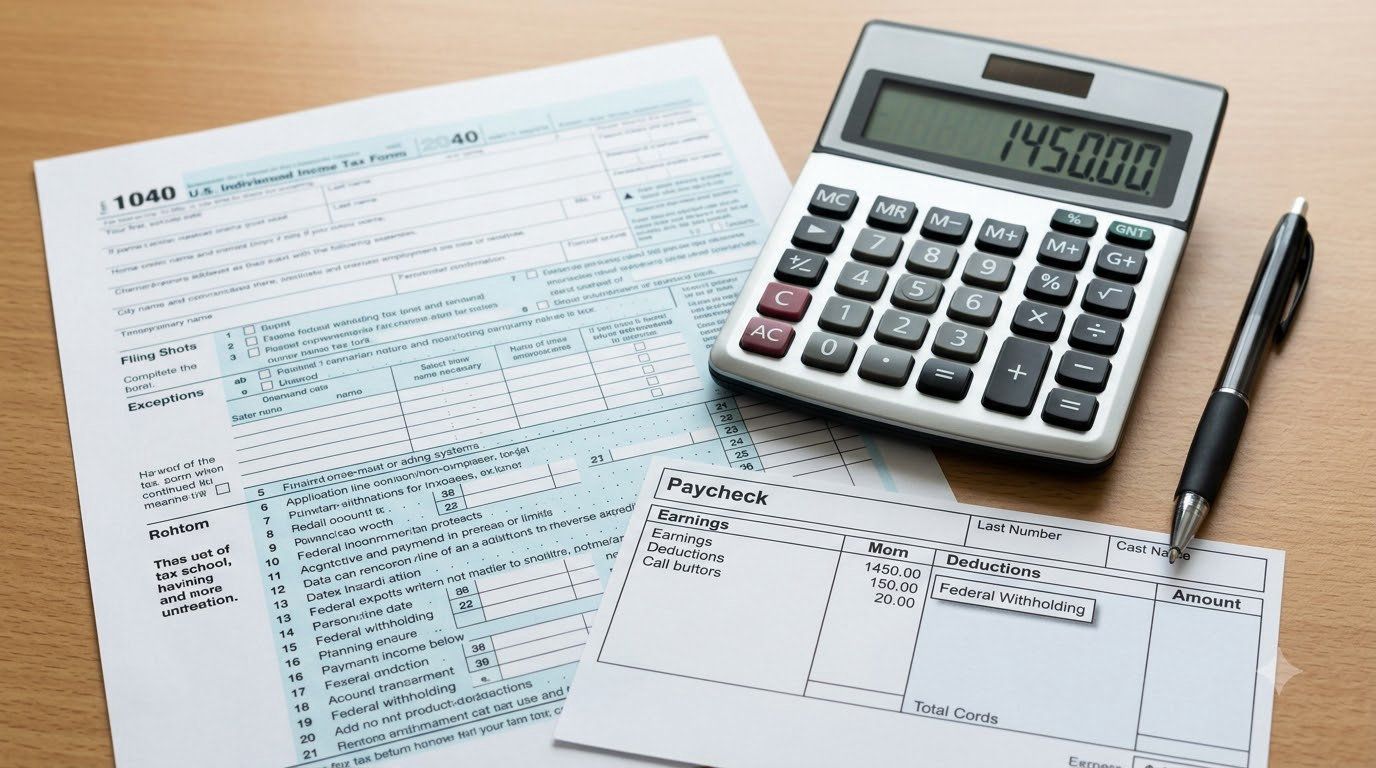
Use the current version of the form from irs.gov, not a copy saved from an earlier year. The 2020 redesign removed withholding allowances entirely, so a form that asks how many allowances you are claiming is out of date, and entering an allowance figure on a current form does nothing useful.
Work down the steps in this order.
- Step 1, filing status. Single or married filing separately on the first line, married filing jointly on the second, head of household on the third. If your status changed this year, this box is the biggest lever you have.
- Step 2, multiple jobs or a working spouse. Check the box if you or your spouse have more than one job, then follow the worksheet instructions. For two working spouses, the cleanest approach is for one of you to claim married filing jointly and the other to claim single or married filing separately, which splits the withholding between the two paychecks without needing the worksheet.
- Step 3, dependents. Enter the Child Tax Credit or other credits the worksheet produces. New parents and anyone who adopted during the year usually see withholding drop the same pay period they submit this.
- Step 4(a), other income. This is where freelance, rental, interest and 1099 income goes when no one is withholding from it. It is the standard fix for a day job plus a side gig.
- Step 4(b), deductions. Enter deductions beyond the standard deduction, such as the excess of itemized deductions over the standard amount. Putting a large number here without documentation is a common cause of an unexpectedly small paycheck.
- Step 4(c), extra withholding. An exact dollar amount per paycheck, and the simplest box on the form. Enter the word EXEMPT here only if you paid no federal income tax last year and expect none this year, and you have to re-claim it every January.
- Step 5, signature and date. An unsigned form can be rejected. The signature is what makes the rest of it valid.
| Goal | What to change | Expected result | Who it suits |
|---|---|---|---|
| Withhold less | Claim dependents in Step 3, add deductions in 4(b), or reduce the amount in 4(c) | Larger take-home pay each period | New parents, buyers with big itemized deductions, anyone clearly over-withholding |
| Withhold more | Add a second job or 1099 income in 4(a), or enter a larger figure in 4(c) | Smaller paychecks, less owed in April | Dual-income households, gig workers, anyone heading into a bill in April |
| Leave it alone | Nothing | Refunds in the spring, a slow year | People who want withholding to act as a forced savings plan |
One thing worth saying plainly: adjusting your W-4 changes when the tax comes out, not how much you owe. A large refund is money you already earned, handed back to you months after the fact. Nobody is paying you interest for the loan.
Step 4: Submit the Form to Your Employer
Send it to payroll or human resources, never to the IRS. The IRS does not change your paycheck and has no way to do so, which is the most common misdirected form I see in questions on tax forums. Some people mail a copy to the IRS, wait for a response, and lose three weeks while their old withholding keeps running.
Employers are required to begin withholding under the new form as soon as they can, generally no later than the first payroll period that begins at least 30 days after they receive it. In practice most changes appear within one to two pay periods, and larger employers that batch their payroll cycles can take a month. Ask payroll for the effective pay period when you submit, and keep a copy or a screenshot for yourself.
Paper, email and portal submission are all acceptable depending on the employer. Some companies only accept their own portal form, and it may be shorter than the IRS version, so check the HR site before printing anything.
Step 5: Check the Result on Your Next Paycheck
Read the new federal income tax figure on the following pay stub and multiply it by the remaining pay periods in the year. That total, compared against the estimated tax from Step 2, tells you whether you are on track.
If the change did not appear at all, work down a short list. You may have sent it to the wrong address, the form may have been missing a signature, your filing status on the payroll system may be out of sync with what you wrote, or the effective period may simply not have started yet. Resubmitting the same form twice in one week rarely helps and frequently creates two conflicting instructions in the payroll system.
A single paycheck that looks unusual is not always a withholding problem. Bonuses, commission, retroactive pay and expense reimbursements all distort one period without meaning anything changed on your form.
Common Mistakes That Cost People Money
Filing a new W-4 straight after a raise. This is the most common error and it usually cuts the wrong way. A raise moves you into a higher bracket, so keeping the old number guarantees a bill in April. Update the form and re-run the estimator on the same day the new pay rate hits.
Reading an old allowance-based form. Allowances were removed from the form in 2020. Anyone still working from an old PDF or an old memory should download the current version from irs.gov and start again.
Ignoring state withholding. A new Form W-4 only touches the federal slice of the paycheck. State withholding sits on its own state form and changes on its own schedule, so a paycheck can shrink even after a federal adjustment. Check whether your state uses its own certificate or accepts the federal one, and adjust it separately.
Putting side income in the wrong box. Freelance earnings belong in 4(a). Putting them in 4(c) also increases withholding, but it ignores the income when the estimator runs, so the number drifts every time you update the form.
Claiming dependents twice. If both you and your spouse list the same children, one of you is over-withholding. Agree on which return claims the Child Tax Credit and keep the other withholding lighter.
Treating a big refund as a windfall. A refund larger than expected usually means the withholding was too high all year, not that something extra was earned. Budget for next year instead.
Fixing any of these is easy. The harder part is knowing when to look, so re-run the check after a marriage, divorce, birth or adoption, a home purchase, a 401(k) or IRA contribution change, a move to another state, a second job, an unemployment stretch, or a year with unusually high or low income. Once a year as a habit, right around when your last return arrives, catches most of them.
One more thing for 2026: recent federal law raised the cap on state and local tax deductions and introduced deductions for qualified tips and overtime. Those changes affect what you owe at the end of the year, not what your employer withholds today, which is exactly why your paycheck can still look unchanged while your final bill moves. The current IRS instructions are the authority on how the withholding tables reflect them.
Frequently Asked Questions
How long does a new W-4 take to take effect?
Most employers apply a new Form W-4 within one or two pay periods, and federal rules require withholding to change no later than the first payroll period starting at least 30 days after the form arrives. Companies that run payroll in batches can take a month. Check the effective pay period when you submit and confirm the new federal figure on the following stub.
Do I send the new W-4 to the IRS or my employer?
Your employer. The IRS receives your W-2 and the withheld amounts after the year ends, but it never contacts your payroll system and cannot change a paycheck. Sending a W-4 to the IRS does nothing at all, which is a common reason people wait weeks for a change that was never requested. Pension, annuity and IRA payments are the exception: Form W-4P goes to the organization paying you.
Can I change my W-4 more than once a year?
Yes. There is no limit and no waiting period, so you can submit a new Form W-4 whenever your income, filing status, dependents or deductions change. Many people adjust twice, once after a life event and again in December once they know how much is left to earn. Keep the latest version and confirm each change on your next pay stub.
What should I set my tax withholding amount to?
Set it to the figure the IRS Tax Withholding Estimator returns for your expected annual income, filing status and credits. Entering an arbitrary per-paycheck amount only works out if it happens to match your total tax for the year. Remember that the tool is a planning estimate, so re-run it whenever your expected income changes rather than treating the first result as final.
Can I have zero federal income tax withheld?
It is possible, and it is legal, but two things usually follow. You may owe tax in April plus an underpayment penalty if too little was withheld across the year, and you give up the refund you would otherwise collect. A zero withholding figure is also not the same as exempt status, which requires that you paid no federal income tax last year and expect none this year.
How do I change withholding for pension, annuity or IRA payments?
Use Form W-4P, the withholding certificate for pension, annuity and IRA distributions, and send it to the organization paying the benefit rather than to an employer. USA.gov and the IRS both point to this form for non-wage income. If the payment is a direct deposit from a retirement account, check whether the plan requires a separate signed distribution form as well.
Conclusion
Start with your latest pay stub, find the federal income tax line, and annualize it. That single number tells you whether anything needs to change at all, and it takes about two minutes.
If the number does not match what you now earn or owe, run the free IRS Tax Withholding Estimator, complete the current Form W-4, and hand it to payroll. Then read your next pay stub and adjust again if the total still looks wrong. Nobody needs to file a new W-4 every January, but plenty of people who needed one waited a year before noticing.
Rules, rates and form versions change, and your own situation may involve state rules, credits or deadlines that a general guide cannot cover. Treat this as the process, and use the current IRS guidance or a qualified tax professional for the specifics.