
Biweekly mortgage payments mean paying half your monthly principal and interest every two weeks, which produces 26 half-payments, or the equivalent of 13 full monthly payments, in a year instead of 12. That extra payment goes straight to principal, and on a standard 30-year loan it commonly shaves four to seven years off the payoff. The catch is cash flow, because your annual housing outflow rises by roughly one-twelfth of your payment and not every servicer handles a biweekly schedule the way you would expect.
Most of the benefit comes from paying more, not from the biweekly timing itself. That distinction matters, because it tells you when the strategy is worth setting up and when you would be better off sending the same money as one larger payment a year. Both routes cut interest the same way, and the one you pick should be the one you will actually keep doing for a decade.
Below is the honest version: what the payments actually do to your balance, what they cost you in fees and risk, and the profiles of borrower for whom this works well and where it backfires. All figures are illustrative and in US dollars, rounded, and based on standard amortization rather than on any lender’s quote.
Table of Contents
- Biweekly Mortgage Payments at a Glance
- What Are Biweekly Mortgage Payments?
- How Do Biweekly Mortgage Payments Save Money?
- What Are the Pros of Biweekly Mortgage Payments?
- What Are the Cons and Risks?
- How Do You Make Biweekly Mortgage Payments Work?
- How Much Can You Save?
- Who Should Choose Biweekly Mortgage Payments?
- Biweekly vs. Extra Principal vs. Making One Extra Payment
- Questions to Ask Your Mortgage Lender
- Frequently Asked Questions
- Do biweekly mortgage payments reduce my taxes?
- How are property taxes and homeowners insurance affected when I pay biweekly?
- Can I make biweekly mortgage payments and still pay extra toward principal?
- What happens if I need to change my mortgage payment later?
- Does every mortgage lender allow biweekly payments?
- Bottom Line
Biweekly Mortgage Payments at a Glance
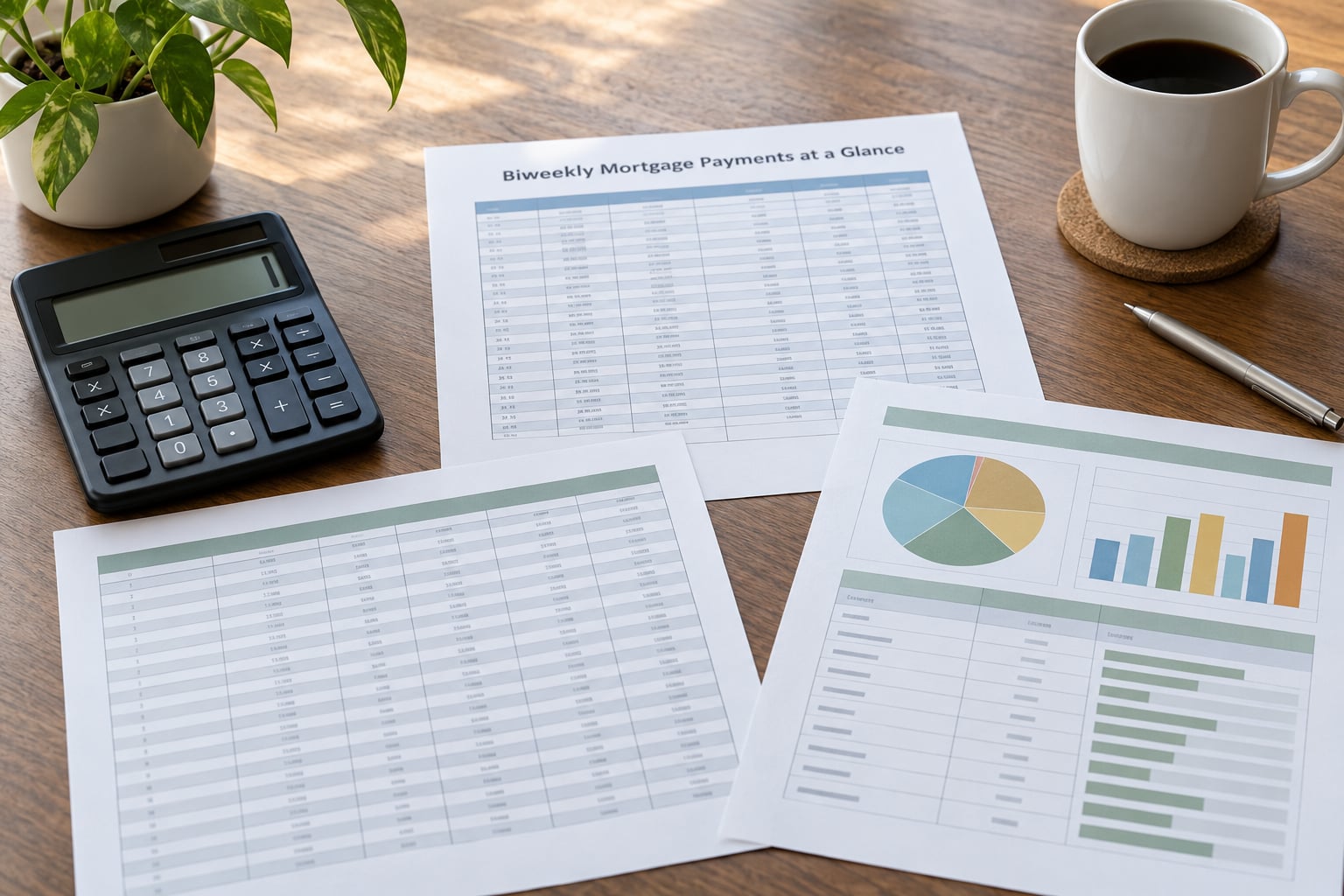
The table below sets a standard monthly mortgage beside two look-alike schedules. They look identical on a bank statement and produce very different results.
| Criterion | Monthly (baseline) | Accelerated biweekly | Twice a month |
|---|---|---|---|
| Payment frequency | One full payment on the due date | Half payment every 14 days, 26 times a year | Half payment on the 1st and 15th, 24 times a year |
| Full monthly payments per year | 12 | 13 | 12 |
| Extra principal applied per year | None beyond the schedule | About one extra monthly payment | None |
| Interest saved over the loan | Baseline | Typically tens of thousands on a mid-size loan | Essentially nothing |
| Payoff speed on a 30-year loan | 30 years | Roughly 24 to 26 years | 30 years |
| Cash-flow impact | Largest single outflow of the month | Smaller outflows, about 8.3% more per year | Smaller outflows, same annual total |
| Lender availability | Universal | Common, but servicer rules vary | Common |
| Who should consider it | Everyone | Stable income, emergency savings, room in the budget, a goal of paying off early | Households paid twice a month who want smaller bill sizes and nothing else |
The right-hand column is the trap. Splitting a monthly bill into two pieces makes the statement easier to read and changes nothing about the balance after a year.
What Are Biweekly Mortgage Payments?
Biweekly mortgage payments are a schedule change, not a rate change. Your interest rate, loan term, and total of payments remain exactly what the note says; only the timing and size of each payment move.
Take a monthly principal and interest payment of 2,200 dollars. Under a standard schedule you send 2,200 dollars once a month, 12 times a year, for 26,400 dollars. Under an accelerated biweekly schedule you send 1,100 dollars every 14 days, 26 times a year, for 28,600 dollars. The extra 2,200 dollars is one full payment you would otherwise have skipped in December.
Now take a household that pays twice a month and splits 2,200 into two payments of 1,100 on the 1st and the 15th. That is 24 payments, or 26,400 dollars a year, which is identical to the monthly schedule. Borrowers often set this version up by accident, and then wonder why the balance is not moving faster.
How Do Biweekly Mortgage Payments Save Money?
Two separate mechanisms are at work, and they are worth telling apart because only one of them depends on the word biweekly.
| Step | Monthly schedule | Accelerated biweekly |
|---|---|---|
| Payments sent per year | 12 full | 26 half |
| Principal and interest paid per year | 26,400 dollars | 28,600 dollars |
| Extra applied to principal | None | 2,200 dollars |
| Average day principal is reduced | Mid-month | About a week earlier each cycle |
| Effect on future interest | Baseline | Less balance, so less daily interest from that point on |
The first mechanism is the extra payment. Your loan is written to expect 12 payments a year, so the 13th payment has no scheduled use. Servicers apply it to principal, and principal is the only part of a mortgage payment that reduces what you owe. Interest is simply the cost of having owed it.
The second mechanism is timing. Mortgage interest accrues per day on the outstanding balance. If principal comes down on day 3 instead of day 30, roughly four weeks of interest on that slice of balance never accrues. Repeat that 26 times and the gain compounds, though it is the smaller of the two effects by a wide margin.
What Are the Pros of Biweekly Mortgage Payments?
- A shorter payoff timeline. On a 30-year fixed loan, 26 half-payments typically retire the debt four to seven years early. On a 15-year loan the calendar gain is small, but the interest saved is still real.
- Less interest over the life of the loan. Because you are paying down a smaller balance earlier, the total cost falls by a meaningful amount rather than a rounding error.
- Faster equity, and possibly earlier PMI removal. Building equity faster moves you toward the 20 percent threshold. Whether PMI actually drops off depends on the PMI clause in your note and how the insurer handles cancellation, so check the wording rather than assume.
- It removes a monthly decision. Autopay from each paycheck removes the monthly decision about whether to send extra or let it drift into the checking account. That behavioral benefit is the strongest argument for the plan.
- It can match how you are paid. Households paid every two weeks get 26 deposits a year, so a 26-payment schedule lines up with income instead of forcing you to budget two months of housing out of one.
One thing pros lists often skip: there is no prepayment penalty on most standard loans, so biweekly is usually just paying your own money back to yourself earlier. A few notes, particularly older or assumable ones, restrict extra payments in the early years, so read the note before you commit.
What Are the Cons and Risks?
- Your annual outflow goes up by about 8.3 percent. Biweekly is not a cheaper mortgage, it is a faster one. A household already stretched on a monthly payment can turn a manageable bill into an unmanageable one.
- More payment dates means more chances to miss one. A 26-payment year has fourteen more due dates than a 12-payment year. Missed installments can trigger late fees, and continued delinquency can reach your credit file.
- Program fees quietly reduce the savings. Some lenders sell a biweekly plan with a setup fee or a recurring monitoring charge. A flat annual fee can wipe out the interest savings on a smaller loan, so read the fee schedule rather than the headline.
- Some servicers hold the first half. Plenty of servicers accept biweekly payments but post them on a monthly schedule, or credit the second half first. Borrowers on personal finance forums describe discovering mid-year that the extra half had not touched principal at all. That is the single most common complaint in the forums, and it is invisible unless you check.
- Escrow and insurance can confuse the totals. Your biweekly amount usually covers principal and interest only. Taxes and insurance are still collected monthly or quarterly, so your cash needs do not halve.
- It can be wasted on a loan that will not exist. If you plan to refinance within a few years or list the home within five to seven, most of the interest you save is interest the new loan never charges. On an adjustable-rate loan with a balloon, extra principal may not shrink the balloon the way you expect.
And the biggest one is not really about biweekly at all: if you are carrying high-rate credit card debt or have no emergency cushion, the extra dollars belong there first. Chasing a lower mortgage rate while paying 24 percent to a card issuer is backwards.
How Do You Make Biweekly Mortgage Payments Work?

A biweekly plan fails on logistics far more often than on math. Work through these in order.
- Read the note. Find the prepayment section. Look for prepayment penalties, restrictions on extra payments during the first years, and PMI clause wording on cancellation.
- Ask the servicer two specific questions, in writing. Do you apply each payment on the date I make it, or do you hold funds until the monthly due date? And will extra amounts be designated principal only, or do you apply them to escrow first? Get the answer in an email, not a phone call, because it becomes the baseline if things go wrong.
- Set the amount and the interval deliberately. Use the exact half of your current principal and interest amount on a 14-day interval. Some servicer portals offer a biweekly toggle; if yours does not, schedule two recurring transfers yourself.
- Fund the other half. On the day you make the half payment, move an equal amount to a separate account. That is the payment you would have made the following month, and it stops the schedule from feeling like new spending.
- Mark every payment. Use the portal note field or the designation line on the payment to say principal only. Without it, some servicers route the extra money to future installments rather than principal.
- Recalculate after any change. A rate adjustment, refinance, modification, or recast resets the principal and interest figure. Re-derive your half payment at that point instead of letting an old number run.
Then verify, once a quarter, because this is the part almost nobody does. Check the principal balance and compare it with the amortization schedule for a standard schedule. After twelve months you should be roughly one monthly payment ahead. If you are not, the extra money is sitting in an interest or escrow bucket, and a phone call to the servicer is the fix. Also read the interest figure on each statement: interest equals payment minus principal, and watching that line shrink is the most honest report card you will get.
How Much Can You Save?
Three sample loans, all 30-year fixed, all principal and interest only, all with the same accelerated biweekly schedule of 26 half-payments. Figures are rounded, illustrative, and not a quote or a promise; your own results depend on your balance, rate, term, and how your servicer applies extra payments.
| Loan profile | Monthly P and I | Total interest, monthly | Total interest, biweekly | Interest saved | Term |
|---|---|---|---|---|---|
| 200,000 dollars at 6.25 percent | 1,231 | 243,300 | 189,300 | about 54,000 | 30 years to about 24 years 4 months |
| 350,000 dollars at 6.5 percent | 2,212 | 446,400 | 343,500 | about 103,000 | 30 years to about 24 years 2 months |
| 500,000 dollars at 6.75 percent | 3,243 | 667,500 | 508,400 | about 159,000 | 30 years to about 23 years 11 months |
Notice the pattern in the last column. Every one of these loans pays off in roughly the same window, because the extra payment scales with the loan. Notice too that the dollars scale much faster than the years, which is why a large balance makes the strategy feel dramatic and a small one makes it feel pointless. Both are correct for the same reason.
Change the rate and the gap narrows. At a low fixed rate the dollar savings shrink considerably, so the case for biweekly weakens. Change the term and the years shrink. Run your own numbers through an amortization calculator with an extra-payment field rather than assuming your results match a table.
Who Should Choose Biweekly Mortgage Payments?
Biweekly suits you if your income is steady, you have several months of expenses saved, your monthly budget has genuine slack, and your goal is to retire the debt sooner at a rate worth paying down. It suits you strongly if you carry a mortgage at 6 percent or above, since that is the range where the interest math is most rewarding.
Slow down or pick a different route if any of these describe you:
- Tight cash flow. If the monthly payment is already a stretch, moving to 26 payments a year will break something. Fix the budget first.
- A low fixed rate and no other goals. A 3 percent mortgage is cheap money. Put the extra dollars toward retirement instead.
- High-rate debt elsewhere. Credit cards at 20 percent and up outrank your mortgage every time.
- A refinance or sale planned within a few years. The interest you save is mostly interest nobody charges you.
- An adjustable-rate loan you expect to reset. Extra principal on an ARM with a balloon may not reduce the amount due at maturity.
- Variable or self-employed income. A fixed 26-payment schedule fights months when the money does not arrive.
If you are near retirement and want lower housing costs later rather than faster equity now, extra principal is still the right tool. It just does not have to run on autopilot.
Biweekly vs. Extra Principal vs. Making One Extra Payment
This is the most asked question in homeowner forums, and the honest answer is uncomfortable for both camps. At the same total dollars per year, biweekly and one extra annual payment land within a few months of each other. The difference is behavior, not arithmetic.
| Factor | Biweekly program | Manual extra principal payments | One extra payment a year |
|---|---|---|---|
| Annual extra principal | About one monthly payment | Whatever you choose each month | One monthly payment |
| Ease of budgeting | Easier, 26 small transfers | Harder, one monthly decision | Easiest, once a year |
| Automation | High if set up as autopay | Manual every time | Depends on a calendar reminder |
| Flexibility to scale up or pause | Low, the schedule is rigid | High, you decide each month | High |
| Interest reduction at the same total | Near identical | Near identical | Near identical |
| Best for | Automatable borrowers who will not stop | Variable income, bonuses, irregular windfalls | Simple one-and-done annual habit |
Manual extra payments win on control, which is why personal finance communities lean that way. You can drop 300 dollars into principal after a bonus and 1,000 after a tax refund, or skip a month when the car needs repairs. A biweekly program asks for a fixed commitment in a year when your income is anything but fixed.
One extra payment a year is the sleeper option. Same interest reduction, no fees, no servicer quirks, nothing to verify. Its only weakness is that it depends on a yearly act of memory. Where it clearly wins is when the money arrives in a lump: an inheritance, a bonus, a tax refund, a down payment you no longer need. When cash comes in unevenly, send it straight to principal and skip the biweekly structure entirely.
Questions to Ask Your Mortgage Lender
Most disagreement with biweekly comes from assuming your lender behaves like the last one. Before you enroll, ask:
- Do you apply each payment when I make it, or do you hold funds until the monthly due date?
- Will extra amounts be applied to principal only, or to escrow and future installments first?
- Does the portal offer a biweekly option, and does it apply to principal and interest only?
- Are there setup, monitoring, or annual fees on the program?
- Does my note contain a prepayment penalty or an early-years restriction on extra payments?
- What does my PMI clause require for cancellation?
- How often is my escrow account recalculated, and could faster principal change my payment?
- Will you provide a written payoff quote showing the principal balance and remaining term?
- What happens to my schedule if I refinance, recast, or modify the loan?
Ask number one and number two every time. Those two answers decide whether the program does anything at all.
Frequently Asked Questions
Do biweekly mortgage payments reduce my taxes?
No. Biweekly payments change when principal leaves your account, not how your home is taxed. Your property tax bill is set by the local assessor, and your mortgage interest deduction still depends on the interest you actually paid during the year, which a faster payoff lowers over the long run. You may still claim the home sale exclusion when you sell, subject to the two-year ownership and use tests.
How are property taxes and homeowners insurance affected when I pay biweekly?
Usually not at all. A biweekly schedule normally applies to principal and interest only, while escrow for property taxes and homeowners insurance is still collected monthly or quarterly. Faster principal does not lower your tax assessment or your insurance premium. One thing to expect is an escrow recertification: if your taxes or premium rise at your next review, your payment goes up even as the principal portion gets smaller.
Can I make biweekly mortgage payments and still pay extra toward principal?
Yes, and most servicers allow it, though you should ask before you assume. Keep a separate payment for lump-sum money such as a bonus or tax refund, and designate it principal only in the portal note field or on the payment stub. Two cautions: confirm the extra amount is not being routed to escrow or future installments, and check your note for prepayment restrictions in the early years of the loan.
What happens if I need to change my mortgage payment later?
You can change it, but the schedule you set is not permanent. A refinance, recast, rate adjustment on an adjustable-rate loan, or loan modification resets your principal and interest figure, and you would recalculate your half payment from the new amount. If you need a payment holiday or a temporary reduction, talk to your servicer before missing a payment rather than after, since hardship options are far easier to arrange in advance.
Does every mortgage lender allow biweekly payments?
No, and this is where most of the surprises come from. Nearly all servicers will accept an extra payment, but a good number of them simply hold the first half until the second arrives and post it on the normal monthly schedule, which cancels the benefit entirely. Some lenders also sell a biweekly program with setup or monitoring fees. Ask in writing how and when payments are applied, and check for fees before enrolling.
Bottom Line
Biweekly mortgage payments pros and cons come down to one honest trade: you give up about one monthly payment worth of flexibility each year, and in exchange the loan retires four to seven years early with meaningfully less interest. That is a good deal for a household with steady income, real savings behind it, and a mortgage rate worth attacking, and a poor one for everyone else.
Start by doing two things. Run an accelerated biweekly plan and a standard monthly budget with the same extra dollars through an amortization calculator and compare the payoff dates side by side. Then ask your lender, in writing, exactly when and where each payment lands. If the answer is vague, skip the program and send one large principal-only payment a year instead. You will get nearly the same result with none of the operational risk.