A Loan Estimate is a standardized three-page form that shows the loan terms you asked for, your interest rate and projected monthly payment, every estimated closing cost, and the cash you will need to bring to closing. Lenders must hand it to you within three business days of receiving your application. Here is how to read a loan estimate page by page, in the order the numbers actually matter.
Most of the confusion comes from reading the form in the wrong order. Borrowers start at the fee section because the numbers are the biggest, then bail. Start with Page 1 instead, where the terms are, and everything on Page 2 and Page 3 becomes something you can check against a decision you have already made.
The form itself is not a private document. The Consumer Financial Protection Bureau’s TILA-RESPA Integrated Disclosure rule, part of the Know Before You Owe reforms, requires every lender to use the same three-page layout. That is the whole reason you can put two lenders side by side and compare them field by field.
Rates, fees and disclosure rules vary by state and change over time, so treat what follows as general information rather than advice about your own loan. If a number looks wrong, the loan officer is the person who has to explain it.
Table of Contents
- What You Need
- How to Read a Loan Estimate Page by Page: Step by Step
- Start With the Loan Summary on Page 1
- Understand the Rate and Loan Type
- Break Down the Monthly Payment
- Review Origination and Third-Party Fees
- Check Cash to Close and Prepaid Items
- Compare the Estimate With Other Loan Offers
- Ask Questions Before You Commit
- Common Mistakes
- Frequently Asked Questions
- Can a loan estimate change after I receive it?
- How do I compare two loan estimates fairly?
- What is the difference between the interest rate and APR?
- Can I shop for services listed on a loan estimate?
- When will I receive the final loan terms before closing?
- Should I pay a fee to lower the interest rate?
- Conclusion
What You Need
You need the Loan Estimate itself, a copy of what you originally asked the lender for, and enough comparable material to check the numbers against. Six things make the read much faster.
The Loan Estimate, printed or as a PDF. Do not rely on a lender’s web dashboard summary. The form has line items the portal leaves out, and those are usually the ones worth negotiating.
Your original application terms. Write down the loan amount, term, down payment, purchase price and product you requested. You are checking the form against your own memory, and memory is unreliable three weeks after an application.
The property’s tax bill and an insurance quote. These two numbers drive most of the escrow line. Having them lets you tell whether the estimate is real or a placeholder.
A calculator and a comparison sheet. A basic mortgage payment calculator is enough. The comparison sheet matters more, and it should have one row per lender and one column per line item.
Estimates from at least two other lenders. One estimate tells you nothing about whether the terms are good. Two tell you a little. Three, built on identical assumptions, tell you something real.
Your closing date, and the three business days before it. The final numbers arrive on the Closing Disclosure at least three business days before closing. If you intend to compare your estimate against that document, you have to keep the estimate exactly as it arrived.
One point to be clear about up front: the Loan Estimate is an estimate. It is not a final statement of what you owe, and it is not your approval. The document that binds the transaction is the Closing Disclosure, and the estimate is the tool you use to get to that document with your eyes open.
How to Read a Loan Estimate Page by Page: Step by Step
Seven passes, top to bottom. The order matters, because each page answers a question raised by the one before it.
Start With the Loan Summary on Page 1
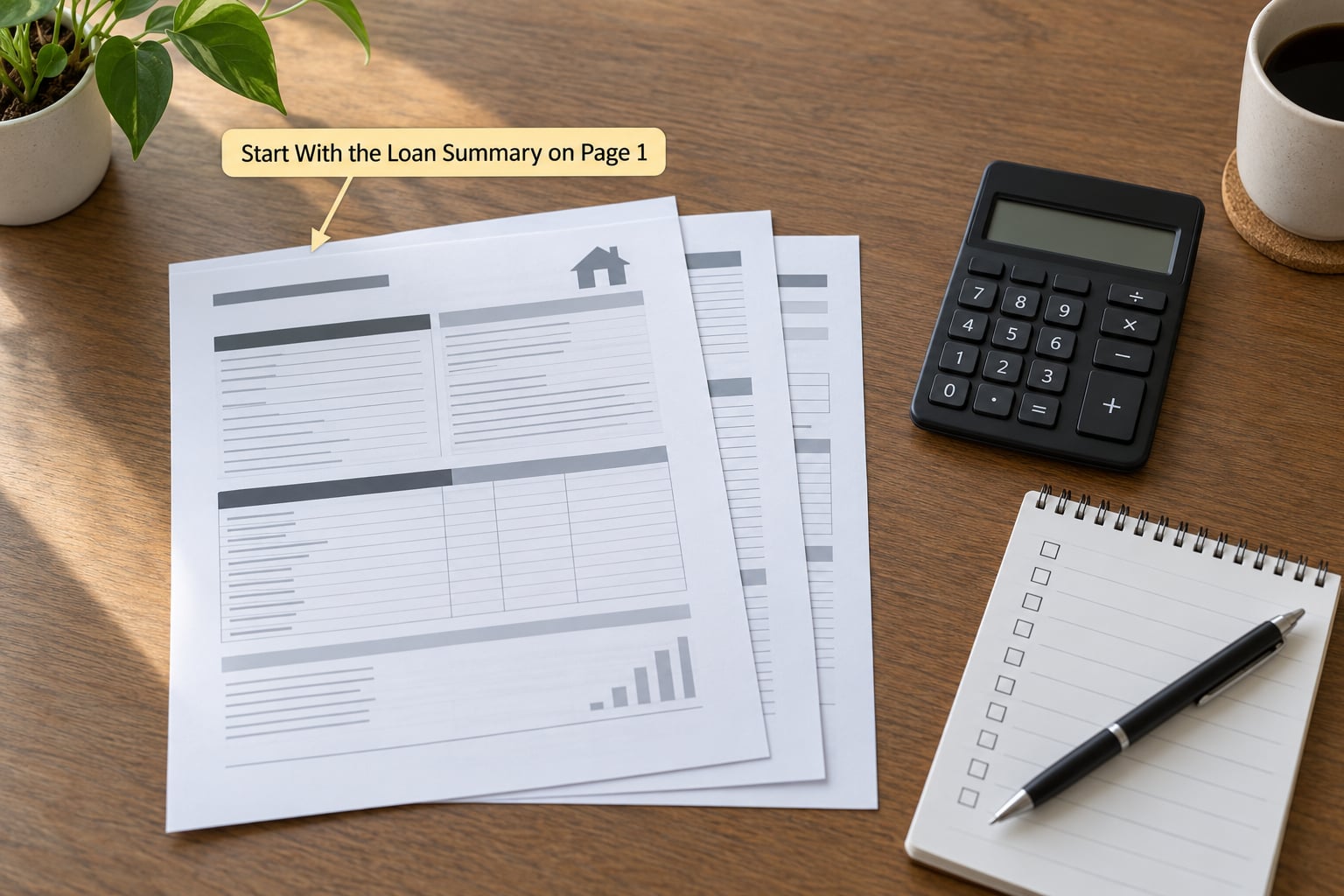
Page 1 opens with the transaction basics: your name, the property address, the purchase price, the loan amount, the loan term, and the purpose of the loan. Confirm every one of those against what you asked for before you read a single fee.
Confirm the terms on the Loan Estimate match the loan you intended to request: same amount, same term, same property, same purpose. Then flag anything you did not ask for.
Three flags are worth pausing on. A rate-lock line that reads not locked means the rate can still move, and it usually will. A balloon payment means the balance does not amortize to zero over the term. A prepayment penalty means you would pay a fee to pay the loan off early, which matters a great deal if you might sell or refinance within a few years.
Check the loan type too. A conventional, FHA, VA and USDA loan carry different mortgage insurance and different fee treatment, and the same house priced the same way can produce a very different Page 2 depending on which program you are using.
There is also a clock running. You generally have 10 business days from receiving the Loan Estimate to signal your intent to proceed, and once you do, the terms are treated as accepted. A revised estimate after that point needs a valid changed circumstance behind it. Ten business days is not a lot of runway to compare three lenders, so start early.
Understand the Rate and Loan Type
The note rate is the percentage you actually pay on the balance each month, and it sits in the Loan Terms box on Page 1. Next to it, check whether the rate is fixed or adjustable, and whether the term is fixed, five years adjustable, or something else. An adjustable rate usually carries a lower note rate and a higher APR, which is exactly the comparison the form is designed to force.
Read the rate basis line carefully. A purchase usually bases the rate on the purchase price, a refinance on the appraised value, and sometimes on the balance if that is lower. A rate quoted against a higher base sounds better than it is, so know which base your lender used.
Then look at APR. APR is the note rate plus certain fees, spread across the life of the loan, and it exists so that two lenders with different fee structures can be compared on one number. APR is useful and it is not your interest rate. Do not sign expecting the APR to be what hits your payment.
Discount points deserve their own minute. One point costs 1 percent of the loan amount and buys down the note rate. On a 360,000 dollar loan that is 3,600 dollars per point. Whether points pay off depends on how long you keep the loan, so check the payment reduction on the form and do the arithmetic against your own timeline rather than trusting a salesperson’s enthusiasm.
Break Down the Monthly Payment
The Projected Payments box shows what you expect to pay each month, and it is almost never just principal and interest. It usually stacks four or five charges on one number, which is where a lot of first-time buyers get stuck.
Find the principal and interest line first. Everything else sits on top of it: property taxes, homeowner’s insurance, mortgage insurance if the loan carries it, and sometimes condo or HOA dues, flood insurance, or special assessments. Pull them apart one at a time.
Then ask the question the form cannot answer for you: will each of those amounts stay the same? Your principal and interest payment is fixed for the life of a fixed-rate loan. Your taxes and insurance are not. They are estimates based on this year’s bills, and a reassessment or a new policy can move them.
One quick sanity check on the principal and interest figure. For every 100,000 dollars borrowed at a 30-year fixed rate, expect roughly 600 to 700 dollars a month, depending on where the rate sits. If the form shows something far outside that range for the term, ask before you go further.
Review Origination and Third-Party Fees
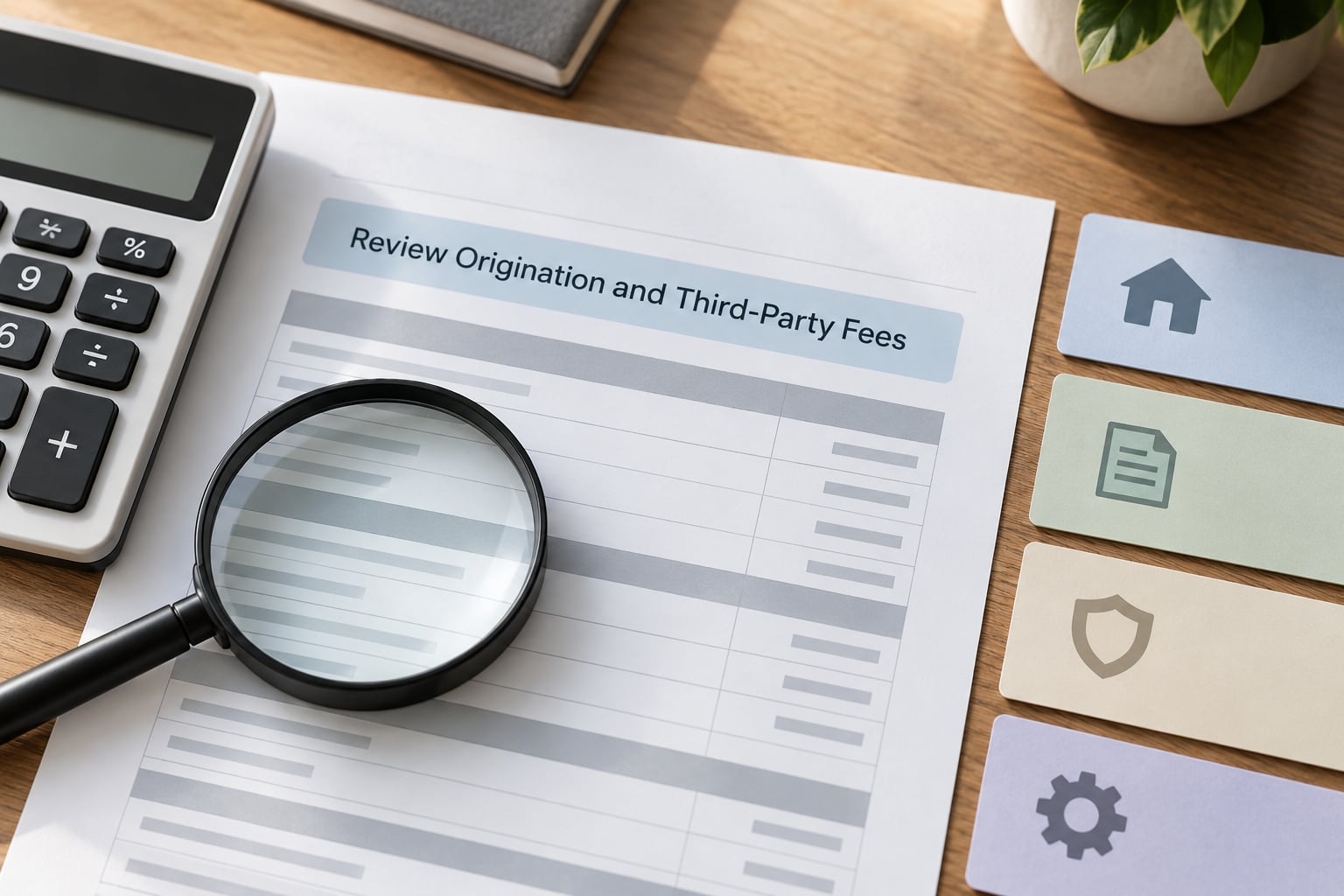
Page 2 splits fees into three boxes, and the split is the single most useful thing on the page. Section A, origination charges, is the lender’s own fee. Section B holds services you cannot shop for, like the appraisal, the credit report, and the flood determination. Section C holds services you can shop for, like the title search, title insurance, a survey, and settlement services.
Start with Section A. It should show an origination charge, sometimes an administration fee, and any discount points. Ask for the same work quoted as a percentage of the loan amount rather than a flat figure, because that is the only way to compare it against another lender’s number. An origination charge of 1 percent on a 360,000 dollar loan is 3,600 dollars; the same lender quoting a flat 1,200 dollars on a larger loan is doing the same work for less.
Section B is short and largely fixed. The appraisal, the credit report, and the flood determination are selected by the lender, and you are not going to find a cheaper appraiser. Read them anyway, because duplicate or oddly named charges sometimes show up here.
Section C is where buyers have the most control and use the least. Title search and title insurance are genuinely shoppable, and so is the survey if the property needs one. A title and settlement fee in the several-hundred-dollar range is ordinary in most markets, while a figure many times that is worth a phone call. Tell the lender, in writing, that you are shopping, and give them the provider’s contact information with enough time for the paperwork.
One more thing to know about these boxes: which category a fee sits in determines how much it is allowed to rise between the Loan Estimate and closing. Fees in the zero tolerance category cannot increase at all, and the remaining charges are grouped under a 10 percent cumulative limit, calculated as a share of the original estimated amounts rather than the total of everything on the form.
Check Cash to Close and Prepaid Items
Estimated cash to close is the actual money you bring to the closing table, and it is different from closing costs. Closing costs are the fees and prepaid items on Page 2. Cash to close is those costs plus your down payment and minus any credits, including seller credits, lender credits, and any excess you overpaid toward the loan.
Worked example, using a 400,000 dollar purchase with 40,000 dollars down and a 360,000 dollar loan. Closing costs of about 11,000 dollars plus a 40,000 dollar down payment gives roughly 51,000 dollars of estimated cash to close. If the seller contributes 6,000 dollars toward costs, your cash drops to about 45,000 dollars. The math is laid out in the Calculating Cash to Close table at the top of Page 2, and it is the only place on the form that shows you the real out-of-pocket number.
Below that, Section F lists other prepaid items: the first year of homeowner’s insurance if you are not escrowing it, and prepaid interest, which covers the days between your closing date and the end of the interest period your first payment covers. Section G holds your initial escrow payment, and Section H shows what the lender expects to collect for taxes and insurance going forward.
Treat every figure in that block as provisional. Estimates move, and the loan officer should be able to tell you which assumptions are driving the numbers. If a tax figure is a placeholder, ask what will replace it and when.
Compare the Estimate With Other Loan Offers
Comparing two Loan Estimates only works if the underlying assumptions match. Same purchase price, same down payment, same loan amount, same term, same property, same day. Get all your estimates as close to the same date as you can, because pricing moves.
When the assumptions line up, put these in the same column: note rate, APR, discount points, total of Section A, total of all closing costs, estimated cash to close, rate lock length, and the projected principal and interest payment.
Here is the part people miss. The lowest note rate is not automatically the best loan. One lender can beat another on rate and lose on fees, and the gap only shows up when you add up what you pay at closing plus what you pay each month. Do that arithmetic yourself rather than comparing a single number in a column.
Two identical loans can also show different monthly payments, and that is normal rather than an error. Each lender estimates your property taxes and insurance separately, and a difference in those assumptions shows up in the escrow figure. When the principal and interest portions match but the totals do not, look at the escrow line before you accuse anyone of anything.
Lastly, ask about lender credits while you still have leverage. A lender willing to credit part of the fees is a real concession, and borrowers rarely ask. It costs the lender money, which is exactly why it is worth requesting.
Ask Questions Before You Commit
Buyers on r/FirstTimeHomeBuyer keep posting estimate screenshots and asking the same question: is this fee normal? It is a fair question and the answer is always that you should ask. A short script works better than silence, and it works better than an accusation.
Ask which fees in Section A are required and which are negotiable, and ask for the origination charge expressed as a percentage of the loan amount. Ask which Section C services you are permitted to shop and how much time you have to name a provider. Ask what the lender credits would look like if you asked for one.
Then ask the estimating questions. Which tax and insurance figures are behind the escrow payment, and what happens if the reassessment comes in higher? What is the current lock status, and how long does the lock last? What could change between this estimate and the Closing Disclosure, and which of those changes would require a revised estimate?
Send the questions in writing before the 10-business-day window closes. A written question gives you a written answer, and an email is a much better record than a phone call you half remember.
Common Mistakes
Chasing the note rate and ignoring everything else. A rate quoted without its APR and fee total is not a comparison. Fix: compare the APR first, then the total closing costs, then the note rate.
Treating the Loan Estimate as a final statement. It is an estimate that can change, and the document that reflects the actual deal is the Closing Disclosure. Fix: pull your estimate and the Closing Disclosure up side by side and check the rate, loan amount, product, and prepaids on both.
Assuming the escrow amounts will stay where they are. Taxes get reassessed and insurance policies get rewritten. Fix: ask for the assumed tax figure and note the month the estimate was made, then plan for the payment to move upward.
Comparing offers built on different assumptions. One estimate for 20 percent down and another for 5 percent down are not comparable, no matter how tidy the columns look. Fix: request every estimate with the same purchase price, loan amount, and term.
Paying whatever provider the lender names in Section C. Title, survey, and settlement services are shoppable by design, and the label says so. Fix: name your own provider in writing and leave enough runway for the paperwork.
Shopping only one lender. This is the single most common thread across buyer forums and the one with the clearest payoff. Fix: request at least two more estimates in the same week, on the same assumptions.
Two habits close out the read well. Keep every version of the document, including superseded estimates, because the revision history explains the changes. And read the estimate the day it arrives rather than the week of closing, since the 10-business-day intent-to-proceed window is what gives you room to compare at all.
If a Loan Estimate arrives late, arrives with errors, or never arrives, that is a disclosure failure worth raising. The CFPB takes complaints about lenders, and a written complaint to the agency is a genuine option when your loan officer will not answer the question.
Frequently Asked Questions
Can a loan estimate change after I receive it?
Yes. A lender may issue a Revised Loan Estimate only when a valid changed circumstance occurs, such as an appraisal above the purchase price, a flood zone determination, or a change in the loan terms you requested. Each time the form changes, the three-business-day delivery clock restarts for the new document, and you get a fresh chance to compare before moving forward.
How do I compare two loan estimates fairly?
Ask each lender for an estimate on the same day, built on the same purchase price, down payment, loan amount, term, and credit score scenario. Then line up the note rate, APR, discount points, the Section A charges, total closing costs, and estimated cash to close. Identical assumptions are what turn a comparison into a real decision rather than an accident.
What is the difference between the interest rate and APR?
The interest rate, sometimes called the note rate, is what you pay on the borrowed balance each month. The Annual Percentage Rate folds certain fees into that rate so lenders with different fee structures can be compared on one number. That is also why a loan with a lower note rate can show a higher APR when it carries heavier fees.
Can I shop for services listed on a loan estimate?
Section C lists services you can shop for, including title search, title insurance, a survey, and some settlement services. Choose your own provider and give the lender written consent early enough for the paperwork to be done. Section B services, such as the appraisal, the credit report, and the flood determination, are selected by the lender and cannot be shopped.
When will I receive the final loan terms before closing?
The Closing Disclosure reaches you at least three business days before closing. Put it beside the Loan Estimate you received and confirm that the rate, loan amount, product, and prepaid items match. Changes are allowed, but the lender has to point to a valid changed circumstance behind each one, and asking about anything unexplained is entirely reasonable.
Should I pay a fee to lower the interest rate?
Discount points are one route. Each point costs 1 percent of the loan amount and reduces the note rate, so on a 360,000 dollar loan a point runs 3,600 dollars. Compare that cost against how long you would keep the loan. Buyers who expect to move or refinance within a few years often find the points never pay for themselves.
Conclusion
Start at the top of Page 1 and confirm the loan amount, term, purpose, product, and rate-lock status match what you actually asked for. Then compare the note rate and the APR, read every line in Sections A through H, and check the Calculating Cash to Close table to see the real number you will write a check for.
Write your questions down and send them to the loan officer before the 10-business-day window closes. Whether you are reading a loan estimate for the first time or your fifth, that sequence is what turns a dense form into a decision you can defend.