
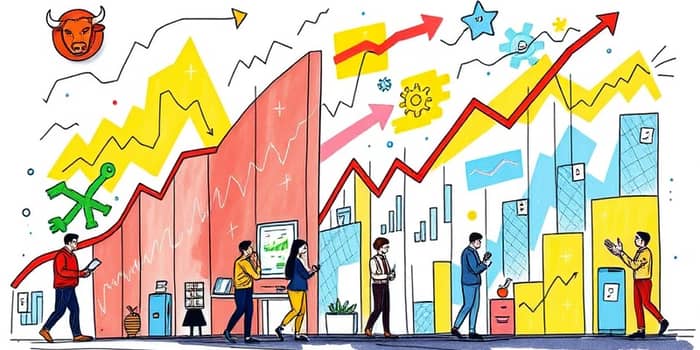
Market cycles shape every investor’s journey, defining periods of growth and decline. By recognizing these patterns, you can navigate uncertainty and capitalize on opportunities. This article breaks down how cycles unfold, why markets often anticipate economic cycles by 6–12 months, and how you can craft a resilient strategy. Whether you’re new to investing or a seasoned professional, understanding these phases will empower you to stay prepared and confident in changing conditions.
The Four Phases of Market Cycles
Financial markets move through predictable stages that repeat across stocks, bonds, commodities, and even cryptocurrencies. Tracking these phases helps you align your actions with market psychology and valuation extremes.
- Accumulation (Stealth Phase)
- Markup (Public Participation Phase)
- Distribution (Topping Stage)
- Markdown (Downtrend Stage)
During Accumulation (Stealth Phase), prices meander within a range as institutional investors quietly buy low. Retail sentiment remains weak, and trading volumes are modest. This recurring phases in financial markets stage lasts until value-seekers finish accumulating positions ahead of broader awareness.
In the Markup (Public Participation Phase), breakout moves attract media attention and new participants. Prices trend higher with accelerating momentum. Early optimism evolves into euphoria, marking the longest and most lucrative segment for many investors.
The Distribution (Topping Stage) begins when bullish enthusiasm peaks. Volume remains high but fails to drive prices upward. Smart money starts to exit as less-informed buyers enter. Subtle divergences between price and volume can signal that a peak is forming.
Finally, the Markdown (Downtrend Stage) triggers widespread selling. Panic and capitulation set in as prices decline, purging excesses built during the bull run. Fear overwhelms greed, and markets often bottom only when sentiment turns unbearably negative.
Linking to Economic Cycles
Market cycles don’t occur in isolation. They parallel broader economic stages—expansion, peak, contraction, and trough—creating a backdrop for asset performance. By comparing indicators and price action, you can refine timing and asset allocation.
Timing Insights and Psychology
History shows that markets often over the long term markets trend upward, but multiple overlapping cycles operate simultaneously. Short-term swings, cyclical trends, and secular shifts may converge, influencing volatility. Recognizing which cycle dominates can sharpen your decisions.
Investor emotions follow a familiar arc: disbelief gives way to hope in early bull markets, which then morphs into optimism and euphoria. At peaks, excessive confidence can blind participants to risk. Conversely, contractions breed fear and despair before a new accumulation phase emerges.
Strategies to Prepare and Act
Rather than chasing every market wiggle, focus on principles that endure through cycles. First, establish an asset allocation aligned with your risk tolerance and goals. Regularly rebalance to maintain target exposures, taking gains from overheated sectors and deploying into undervalued areas.
Next, adopt a systematic planning to buy low approach. Dollar-cost averaging during downturns reduces timing risk and builds positions at attractive valuations. Conversely, consider trimming positions when sentiment and valuations reach extremes.
Rotation across asset classes can also sharpen performance. As inflation picks up, commodities often lead. When recession fears rise, high-quality bonds and defensive equities can offer shelter. Tracking broad indicators—interest rates, credit spreads, and sentiment surveys—provides early warning before price moves confirm shifts.
Building Confidence and Resilience
Mastering market cycles demands both knowledge and discipline. Embrace continuous learning by reviewing historical charts and case studies. A practical step is to study past chart action on weekly timeframe, noting how price, volume, and volatility interact during each phase.
Equally important is emotional control. Fear and greed are powerful motivators that can erode returns. Techniques like pre-defined entry and exit rules, stop-loss orders, and position sizing guard against impulsive moves driven by panic or euphoria.
Finally, view each downturn as an opportunity. Though corrections can feel painful, they also clear the path for future growth. By staying informed and prepared, you transform uncertainty into an edge, positioning yourself for the next upward leg.
Conclusion: Embrace the Cycle
No one can predict every twist and turn in markets. Yet by understanding the management of risk and emotion through these phases, you gain the foresight to act decisively. Market cycles are neither good nor bad—they are the natural heartbeat of financial systems.
When you recognize each phase, align your strategy, and maintain discipline, you make the cycle work for you. Prepare for what’s next, and you’ll navigate downturns with confidence, capturing gains when the next bullish wave begins.
References
- https://hub.tradier.com/articles/the-four-phases-of-market-cycles/
- https://www.heygotrade.com/en/blog/mastering-market-cycle-investing-approach/
- https://www.cooperators.ca/en/personal/resource-centre/plan-ahead/understanding-market-cycles
- https://www.ig.com/sg/trading-strategies/market-cycles--phases--stages--and-common-characteristics-220930
- https://www.rain.com/learn/mastering-market-cycles-5-essential-tips-for-smart-investors
- https://bookmap.com/blog/market-cycles-the-key-to-timely-trading-decisions
- https://www.schwab.com/learn/story/four-stages-stock-market-cycles
- https://www.oanda.com/us-en/trade-tap-blog/trading-knowledge/market-cycles-key-indicators-guide/
- https://www.youtube.com/watch?v=0YZSWfRewYI
- https://chartschool.stockcharts.com/table-of-contents/chart-analysis/chart-annotation-tools/stock-market-cycles
- https://markettimingreport.com/insights/market-timing-the-complete-guide-to-cycle-based-investing/
- https://www.britannica.com/money/market-cycle-investing
- https://www.fidelity.com/viewpoints/investing-ideas/the-market-cycle-and-investors
- https://www.youtube.com/watch?v=5MwRzVTsCgc