
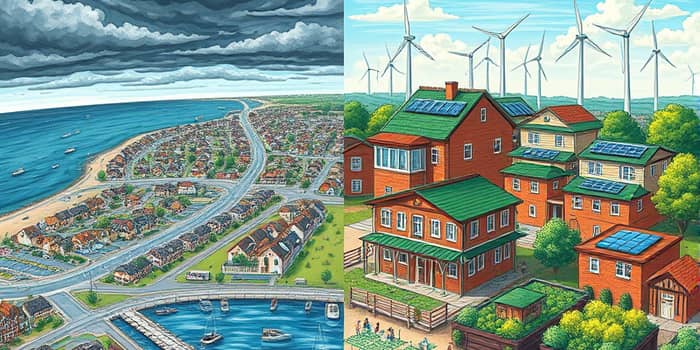
Climate change is reshaping our world, and the real estate sector stands at the forefront of this transformation. As environmental threats mount and regulations evolve, investors, developers, and homeowners must find ways to adapt sustainably.
Far from being a distant concern, climate risks now drive market behavior, influence policy, and determine long-term asset performance. Understanding these dynamics is essential to protect wealth and unlock new avenues for growth.
Understanding Climate Risks in Real Estate
The real estate industry faces both physical and transition risks. Rising sea levels, intensifying storms, and shifting precipitation patterns threaten structures and infrastructure, while regulatory changes and carbon pricing can alter investment returns.
Recent data highlights over 28 billion-dollar climate disasters in 2023 alone, costing nearly $93 billion in damages. These events erode property values, strain local budgets, and increase the cost of capital as lenders and insurers recalibrate risk models.
In addition, the sector accounts for roughly 39–40% of global greenhouse gas emissions. Transitioning to low-carbon materials and energy systems is not just an environmental imperative but also a financial one, given growing consumer demand for eco-friendly properties and corporate sustainability targets.
Insurance Market Disruptions
Insurance has traditionally served as a safety net for property owners, but climate-driven losses have disrupted this balance. U.S. home insurance premiums have soared by 31% since 2019, vastly outpacing inflation and wage growth.
High-risk metro areas illustrate this trend. Miami saw a 322% jump, Jacksonville 226%, and Tampa 213%. Even inland regions, like Sacramento, experienced premium hikes of 137%. As insurers reassess portfolios, many are reluctant to issue new policies or renew existing ones in vulnerable zones.
Policy non-renewals can leave homeowners without coverage, jeopardizing mortgage eligibility and forcing sales at steep discounts. To navigate these challenges, stakeholders should explore innovative products such as parametric policies that trigger payouts based on objective indices, reducing claim disputes and ensuring timely relief.
Engaging proactively with insurers, investing in risk mitigation measures—like flood-proofing and wildfire-hardening—and documenting enhancement efforts can improve insurability and contain premium inflation.
Regional Vulnerabilities and Projections
Geography plays a pivotal role in climate exposure. Coastal metros grapple with storm surges and sea-level rise, while interior regions face heatwaves and drought-induced wildfires. Mapping these exposures helps anticipate value shifts and align capital deployment.
Here is a snapshot of projected insurance premium increases in key high-risk metros:
Many local authorities resist updating flood and fire hazard maps to avoid immediate property devaluation. However, delaying this process can lead to underpriced risk and sudden market corrections when updated data is eventually enforced.
Analysts project that ocean temperatures could rise by up to 3.5 degrees Fahrenheit by 2050, intensifying hurricane categories and expanding flood zones. Proactive municipalities are already integrating green infrastructure, elevating critical assets, and revising zoning codes.
Migration and Market Shifts
Climate revelations are altering migration patterns and consumer preferences. Recent moves illustrate how demographics respond to perceived and real threats:
- Outflows from flood-prone coastal communities accelerate as younger generations seek stability and affordability.
- Increased relocation to counties facing extreme heat but lower flood risk, highlighting differentiated threat perceptions.
- The emergence of a "climate divide" between resilient urban centers and vulnerable rural or coastal areas, amplifying social equity concerns.
This redistribution is reflected in property valuations: resilient cities with robust infrastructure witness steady or rising prices, while high-risk zones see discounts of up to 5% annually. Buyer sentiment, driven by awareness of future risks, now factors into negotiation leverage and long-term financing terms.
Seizing Opportunities in Resilient Real Estate
While climate threats pose challenges, they also create fertile ground for innovation and strategic investment. Those who anticipate and adapt can unlock significant value:
- Prioritize adaptive reuse and redevelopment of existing structures in low-risk areas, capitalizing on urban infill and reducing environmental footprints.
- Invest in climate-resilient building materials and designs such as cross-laminated timber, cool roofs, and flood-resistant foundations to command premium rents and sales prices.
- Leverage modern risk-mapping and analytics technologies to model future scenarios, guiding site selection and portfolio diversification.
- Support community-scale initiatives—like wetland restoration or urban tree canopies—that enhance resilience while generating ecosystem service credits.
Case studies reveal that buildings certified under stringent resilience standards can achieve rental premiums of 5–10% and enjoy lower vacancy rates, translating into durable returns for investors.
Practical Steps for Stakeholders
Stakeholders across the real estate spectrum can take targeted actions to safeguard assets and support community resilience:
- Conduct comprehensive climate risk audits, integrating flood, fire, and heat stress maps into investment analyses.
- Partner with insurers to design parametric and usage-based policies that align protection with specific risk exposures.
- Incorporate fire-resistant materials and designs in new developments and retrofits, reducing potential losses and premiums.
- Advocate for adaptive zoning and building codes that encourage elevation, setback requirements, and green infrastructure installations.
- Engage local communities through participatory planning, ensuring that adaptation measures address social vulnerabilities and generate broad support.
Through these steps, property owners can enhance durability, preserve equity, and contribute to collective climate resilience efforts.
Looking Ahead: Building a Resilient Future
The intersection of real estate and climate change demands a proactive, integrated approach. Traditional investment models must evolve to embrace environmental, social, and governance considerations at every stage of development and management.
By embedding resilience into financial structures—such as green bonds, resilience-linked loans, and impact investment vehicles—stakeholders can align profitability with positive social outcomes. This dual focus not only mitigates risk but also attracts a growing class of values-driven investors.
In the face of escalating climate uncertainties, the real estate sector has an opportunity—and a responsibility—to lead the transition to a sustainable built environment. By adopting future-proof financial strategies and policies, fostering innovation, and championing equitable adaptation, the industry can secure prosperity for both investors and communities in the decades to come.
References
- https://bluehubcapital.org/foreclosure-relief/sun-blog/how-climate-change-impacting-us-housing-market-what-it-means-housing
- https://www.sustainabilityprofessionals.org/climate-risks-in-us-real-estate-a-looming-economic-downturn-despite-political-denial
- https://www.unepfi.org/themes/climate-change/climate-risks-in-the-real-estate-sector/
- https://www.bdo.com/insights/advisory/the-impact-of-climate-change-on-the-real-estate-market-an-insurance-perspective
- https://academic.oup.com/rfs/article/33/3/1256/5735306
- https://www.bradley.com/insights/publications/2024/02/the-climate-bubble-real-estate-and-extreme-weather
- https://www.financialsamurai.com/how-climate-change-may-affect-real-estate-values/
- https://www.realtor.com/advice/buy/climate-risk-generational-housing-wealth/
- https://www.oecd.org/en/publications/2025/11/future-proofing-real-estate-investment_f3d78bbb/full-report/the-state-of-play-climate-related-risks-in-real-estate_52c508a3.html