
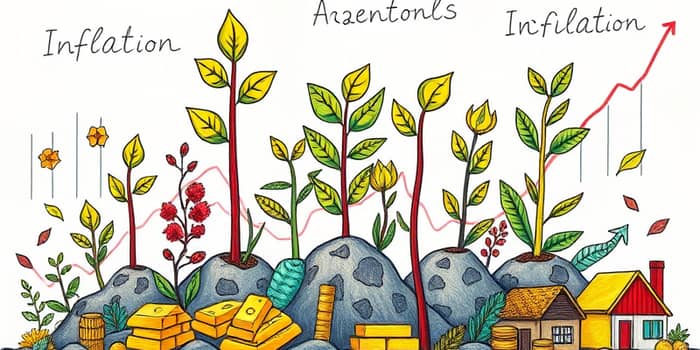
In the wake of sustained price increases, investors face a critical challenge: safeguarding wealth from the silent erosion of purchasing power. From cash holdings that lose value to traditional bonds underperforming in real terms, inflation demands a proactive response. This article outlines comprehensive strategies, blending conservative and innovative approaches, to help you preserve and grow your portfolio in any inflationary environment.
Understanding Inflation’s Impact on Investments
Inflation artificially raises the price of goods and services, effectively erodes purchasing power over time for savers and investors alike. When inflation outpaces bond yields—consider a 3% bond amid 4% inflation—real returns become negative. Even cash sitting in a savings account can shrink in value, undermining long-term financial goals.
Historically, equities have offered the best growth potential in inflationary periods, as companies pass rising costs to consumers. However, performance can vary when interest rates climb above critical thresholds, introducing volatility and short-term drawdowns.
Budget and Tax Optimization
Before diving into asset allocation, review your cash position and tax liabilities. Holding excessive cash may feel comfortable, but it’s a losing proposition when prices rise. Instead, consider:
- Rebalancing emergency reserves to avoid too much comfort in cash by keeping only three to six months of expenses.
- Implementing tax-loss harvesting during volatility to offset capital gains and reduce overall tax drag.
- Placing tax-inefficient assets like high-yield bonds in tax-deferred accounts to shield dividends from immediate taxation.
Such optimizations can add meaningful basis points to your net returns, especially in volatile markets.
Diversification Principles
No single asset class offers a perfect hedge. The cornerstone of resilience is a well-diversified portfolio of stocks and bonds that can adapt as economic conditions shift. Core guidelines include:
- Allocating across equities, fixed income, real assets, and alternatives.
- Limiting diversifiers like commodities and real estate to 25% of your fixed-income allocation to limit diversifiers to twenty-five percent and manage volatility.
- Balancing passive strategies—such as blue-chip index funds—with active approaches like options or tactical sector plays.
Equities and Stocks
Equities have historically produced historical returns exceed inflation rates over multi-decade periods, averaging 7% to 10% per year. Key equity categories include general stock indices for broad market exposure; blue-chip dividend aristocrats offering reliable passive income through decades of consistent increases; sector-specific plays in consumer staples, healthcare, utilities, and energy firms with stable demand; and international equities to diversify across economic cycles and currencies.
Fixed Income and Inflation-Linked Securities
Fixed income remains essential for income and stability, but not all bonds respond equally to inflation. Below is a snapshot of core fixed-income options.
Real Assets and Commodities
Real assets often move with consumer prices, adding an extra layer of inflation resistance. Consider commodities such as energy, industrial and precious metals, and agriculture; gold and other precious metals as a traditional hedge; REITs, which provide real estate exposure with yields around 4%; and infrastructure investments—utilities and transport—that often have inflation-linked revenues and steady cash flow.
Alternatives
Alternative investments can deliver uncorrelated returns but come with unique risks. Popular options include options strategies to hedge or boost profits for active traders; cryptocurrencies like Bitcoin, which some view as a speculative inflation hedge; and renewable energy projects that benefit from government subsidies but may offer low immediate income.
Low-Risk Cash Equivalents
High-yield savings, CDs, money market funds, and short-term Treasuries are FDIC-insured and provide capital preservation. However, when inflation exceeds 3%, as it did in late 2025, these instruments lose real value in purchasing power, making them unsuitable for long-term growth.
2026 Outlook
Looking ahead, sectors such as renewables, blue chips with strong pricing power, and selective alternatives may outperform. Continued central bank vigilance suggests rates will remain elevated, favoring assets that can pass costs to consumers or reset yields quickly.
Historically, the INFL inflation ETF gained 36.8% over 12 months ending September 2025, compared to the S&P 500’s 26.6%. Such data reinforce the need for dynamic allocation and tactical shifts as markets evolve.
Risks and Considerations
Every strategy carries trade-offs. Volatility in equities, default risks in high-yield and floating-rate loans, and illiquidity in real estate and TIPS require careful matching to your risk tolerance and investment horizon. Retirees may favor stability and income, while younger investors can allocate more toward equities and alternatives.
Ultimately, there are no guarantees in any market environment. By embracing broad diversification, prudent tax planning, and ongoing rebalancing, you can navigate inflationary challenges and position your portfolio for resilient growth.
Ongoing inflation concerns into 2026 demand a proactive stance. Use these smart strategies to weather rising prices and build lasting wealth across economic cycles.
References
- https://www.fidelity.com/learning-center/wealth-management-insights/6-ways-to-help-protect-against-inflation
- https://wealthbooster360.com/best-investments-to-beat-inflation/
- https://naga.com/en/academy/inflation
- https://www.captrader.com/en/blog/inflation-protection/
- https://www.fidelity.com/learning-center/trading-investing/inflation-proof-investments
- https://www.americanbullion.com/10-best-investments-in-2026/
- https://www.kiplinger.com/investing/stocks/stocks-to-buy/604680/best-investments-to-inflation-proof-your-portfolio
- https://www.thelandgeek.com/blog-inflation-hedge-investments-2026/
- https://privatebank.jpmorgan.com/apac/en/insights/markets-and-investing/tmt/beyond-bonds-how-to-protect-against-inflation-led-shocks
- https://www.nerdwallet.com/investing/learn/the-best-investments-right-now
- https://www.youtube.com/watch?v=Y917wlg0MS4
- https://www.bankrate.com/investing/best-investments/
- https://www.youtube.com/watch?v=zozDjS5ukZc