
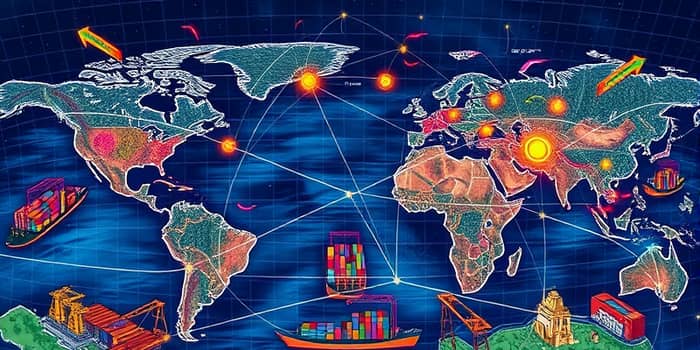
From the quiet streets of small towns to the bustling harbors of international ports, economic activity weaves a tapestry of growth and connection. As local markets evolve, they set the stage for a complex web of trade and finance that spans continents. This article explores the journey from isolated economic loops to the vibrant, interconnected systems shaping our world today.
Local Economic Foundations
The story of modern prosperity often begins in urban centers where merchants, artisans, and entrepreneurs exchange goods and ideas. In many developed economies, vibrant local markets acting as incubators laid the groundwork for broader expansion. Early American cities, for example, thrived on localized financial loops that fostered investment, innovation, and reinvestment in community infrastructure.
However, developing nations sometimes face the risk of remaining trapped in narrow, single-export models. Without diversified industries or sufficient capital retention, these economies can struggle to ignite the necessary cycles of domestic growth. Understanding these foundational dynamics is essential to charting a path toward sustainable global engagement.
Scaling Mechanisms: From National to Global
As economies transition beyond local confines, monetary policy and financial innovations become critical drivers of expansion. Central banks adjust interest rates and manage inflation to stabilize currencies, while trade invoicing in major reserve currencies facilitates larger, cross-border transactions. These mechanisms reduce friction and encourage participation in broader markets.
Exchange rate dynamics play a pivotal role in this scaling process. Advanced economies typically adjust real exchange rates through nominal shifts, whereas emerging markets historically relied on a mix of inflation differentials and rate changes. Since 2007, however, nominal adjustments have dominated worldwide, making currency management a core element of international competitiveness.
Modern Dynamics: Services, Digitalization, and South-South Growth
In recent years, services have surged to represent 27% of global trade, growing by 9% in 2025 alone. Digitally deliverable services now constitute 56% of these exports, underscoring how technology reshapes borders and opens new avenues for collaboration. From cloud computing to remote consulting, the digital revolution has amplified the velocity and volume of exchange.
At the same time, South-South trade has exploded from $0.5 trillion in 1995 to $6.8 trillion in 2025. Asia, Africa, and Latin America now trade more with each other than ever before, reflecting growing regional value chains and shared developmental goals. This diversification adds resilience to global flows, reducing reliance on traditional North-South corridors.
Projection Table: Growth Forecasts for 2026
Risks on the Horizon: Tariffs, Tensions, and Financial Shifts
Despite record-breaking growth, the global trade ecosystem faces significant headwinds. Recent tariff spikes—particularly in manufacturing—have disrupted supply chains before implementation. Geopolitical frictions and protectionist measures threaten to fragment established networks, driving up costs and reducing predictability.
Currency fluctuations add another layer of complexity. The dollar’s strength raises import prices and tightens trade finance, often contracting cross-border flows beyond simple invoicing effects. Net debtor countries, especially those with limited reserves, can experience amplified depreciation during global financial downturns, heightening sovereign vulnerability.
Case Studies: Responses Across Economies
The United States, leveraging deep financial markets and robust institutions, has navigated exchange rate shifts with relative agility, using monetary policy tools to stabilize inflation and maintain export competitiveness. Meanwhile, China’s managed currency regime balances growth objectives with capital controls, allowing for strategic interventions that temper volatility.
Emerging and developing economies demonstrate mixed outcomes. Some nations have embraced regional integration, forging new trade pacts that bypass traditional partners. Others remain exposed to commodity price swings and debt pressures, underscoring the need for diversified export baskets and stronger financial buffers.
Charting a Resilient Path Forward
- Enhance regional trade agreements to build local value chains.
- Invest in digital infrastructure for cross-border services.
- Diversify export portfolios beyond primary commodities.
- Strengthen financial regulations to manage currency risks.
- Promote sustainable, green technologies within trade frameworks.
By adopting these strategies, economies can weather disruptions and foster inclusive prosperity. Embracing diversification, digitalization, and regional cooperation creates a sturdy foundation, enabling both small communities and major powers to thrive within a shared global marketplace.
Ultimately, the journey from local roots to global connections is a testament to human ingenuity and collective ambition. As markets evolve, stakeholders must remain vigilant and adaptive, ensuring that economic exchange continues to uplift societies and forge a more interconnected, resilient world.
References
- https://necsi.edu/economic-dynamics
- https://unctad.org/news/10-trends-shaping-global-trade-2026
- https://www.statista.com/topics/1467/global-economy/
- https://www.aeaweb.org/conference/2024/program/paper/aTdY8iDN
- https://tradingeconomics.com
- https://www.tandfonline.com/doi/full/10.1080/09638199.2024.2407793
- https://www.usitc.gov/research_and_analysis/tradeshifts/2021/macroeconomic_conditions
- https://www.youtube.com/watch?v=Itbnlv2MRbk
- https://www.deloitte.com/us/en/insights/topics/economy/global-economic-outlook/weekly-update.html
- https://www.worldbank.org/en/publication/global-economic-prospects
- https://oec.world/en/
- https://www.oecd.org/en/data/indicators/exchange-rates.html
- https://www.imf.org/external/np/fin/ert/gui/pages/countrydatabase.aspx