
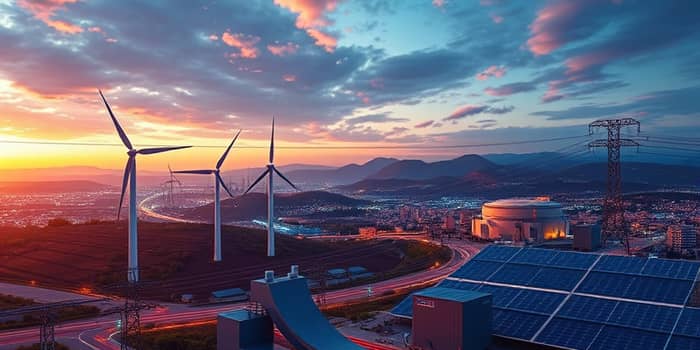
As the world races to decarbonize and meet ambitious climate targets, electricity sits at the heart of a profound transformation. Renewable energy sources, advanced digital technologies, and evolving market models are converging to reshape the grid, presenting both immense opportunities and complex challenges for utilities, regulators, and consumers. Understanding the forces driving this revolution is essential for stakeholders hoping to navigate the shifting energy landscape and build a resilient, efficient, and equitable power system.
Core Market Drivers and Demand Projections
As global energy needs surge, forecasts indicate that Global electricity demand is skyrocketing, with projections showing a 150% increase by 2050 and a 30% rise by 2035. Growth in electric vehicles, data centers, and electrified industries underpins this unprecedented expansion.
In the near term, demand is expected to climb by 25% by 2030, with datacenters and AI workloads driving a 2–3× increase in electricity consumption in certain regions. This rapid electrification of industry calls for robust supply-side planning and robust demand forecasting.
Technical Infrastructure Challenges and Solutions
Decades-old transmission and distribution networks are being asked to perform beyond their original design. Integrating variable renewables and meeting surging loads requires significant upgrades to ensure reliability and safety. Key stakeholders are turning to advanced power control flow technologies and digital monitoring to modernize the grid.
To address these challenges, utilities and grid operators are investing in key infrastructure upgrades:
- High-efficiency conductors to reduce transmission line losses by 10–20%
- Modern transformers with high-efficiency designs cutting energy consumption by up to 12%
- Volt/VAR optimization (VVO) systems for enhanced voltage control and reactive power management
Integrating variable renewable energy sources also demands updated protection schemes, advanced inverter controls, expanded communications networks, and dynamic line rating technologies to ensure safe two-way power flows and system resilience.
Distributed Energy Resources and Localized Solutions
Distributed Energy Resources (DERs) are transforming the grid from centralized generation to a decentralized model. When properly integrated, decentralized energy resources integration can improve flexibility and reliability.
- Utility-as-a-platform services facilitating peer-to-peer energy trading and demand response aggregation
- Energy-as-a-service models that allow customers to subscribe to clean energy solutions without heavy upfront investments
- Microgrid-as-a-service offerings that provide remote and rural communities with resilient local power from renewable sources
Demand-Side Management and Consumer Engagement
As end users play an increasingly active role, strategies like dynamic pricing and demand response are crucial. Programs that adjust rates based on real-time grid conditions have demonstrated reductions in peak load by 15% to 20%, alleviating stress on transmission and distribution assets. By introducing dynamic pricing and demand response schemes, both utilities and customers can benefit through cost savings and improved grid stability.
Innovations such as vehicle-to-everything (V2X) technology further unlock the potential of electric vehicles to act as mobile storage assets, while smart home devices enable households to shift consumption to off-peak periods, creating a more balanced load profile.
Regulatory and Policy Framework
Effective regulation underpins the energy transition. Flexible, region-specific policies enable diverse market participants to contribute. For instance, the Federal Energy Regulatory Commission’s Order No. 2222 paves the way for distributed resources to participate in wholesale markets, enhancing competition and diversity.
Incentive-based regulation is also gaining traction, aligning utility revenues with performance outcomes rather than capital deployment alone. Connecticut and Hawaii have already introduced frameworks rewarding efficiency, reliability, and customer satisfaction, signaling a shift toward outcome-driven oversight.
Critical Enabling Factors and Stakeholder Coordination
Four interdependent factors will dictate the pace and success of grid modernization:
- Capital availability for large-scale deployments and technological innovation
- Talent accessibility to build and maintain sophisticated digital and physical infrastructure
- Technology readiness to integrate advanced monitoring, control, and storage solutions
- Business models that incentivize performance and customer engagement
Collaboration among regulators, utilities, technology providers, financiers, and community stakeholders is essential to overcome the complexity of multi-jurisdictional projects and avoid delays often caused by fragmented decision-making. Only through coordinated efforts can the modern grid achieve its full potential.
Financial and Equity Considerations
Transforming the grid necessitates substantial investment, with the cost burden largely borne by distribution and transmission upgrades. Ensuring that modernization enhances access to clean, affordable, and reliable power for all communities must be a priority.
Equity considerations demand targeted policies and funding mechanisms to prevent disproportionate impacts on low-income and historically underserved populations, while enabling universal benefits from renewable energy integration.
Investment Themes and Future Directions
Market opportunities arise for companies that deliver capital efficient and equitable transition solutions, from interconnection bottleneck relief to resilient on-site generation for data centers and fleets. The growth of AI, electrified transport, and digital industries will continue to drive demand, reinforcing the need for a flexible, self-optimizing grid.
Blockchain-based peer-to-peer trading platforms and advanced analytics will unlock new revenue streams and improve resource utilization. Ultimately, a modern grid will be defined by its ability to adapt in real time, balancing supply and demand with minimal human intervention.
Key Metrics and Projections
The energy transition presents both challenges and unprecedented opportunities. By harnessing advanced digital tools, modernizing infrastructure, and forging equitable policy frameworks, stakeholders can build a resilient, sustainable grid that empowers industries and communities alike.
This dynamic landscape offers a once-in-a-generation chance to reshape our energy systems, reduce carbon emissions, and ensure that the benefits of clean power reach every corner of the globe.
References
- https://www.deloitte.com/us/en/insights/industry/power-and-utilities/grid-modernization-and-expansion-critical-for-clean-energy-future.html
- https://matterport.com/blog/power-grid-modernization
- https://www.ibm.com/thought-leadership/institute-business-value/en-us/report/power-grid-modernization
- https://www.joinact.org/blogs/emerging-trends-in-grid-modernization-navigating-the-complexities-of-a-changing-energy-landscape
- https://www.jpmorgan.com/insights/banking/commercial-banking/grid-modernization-the-benefits-of-smart-grids
- https://www.lgt.com/global-en/market-assessments/insights/sustainability/powering-the-world-333860
- https://www.edf.org/energy-transition/modernizing-the-grid
- https://www.ieee-pels.org/magazine/the-energy-transition-and-a-bifurcating-grid-a-crisis-in-the-making-energy-transition-perspectives/
- https://www.energy.gov/oe/grid-modernization-and-smart-grid
- https://neiengineering.com/market-trends-driving-grid-modernization/
- https://sepapower.org/knowledge/the-aging-us-power-grid-navigating-toward-modernization/
- https://www.sssclutch.com/en/articles/what-is-the-energy-transition/
- https://www.wri.org/insights/state-clean-energy-charted
- https://www.weforum.org/publications/fostering-effective-energy-transition-2025/in-full/redefining-global-energy-systems/