A sinking fund is money you set aside in small, regular amounts for a specific expense you already know is coming, so the bill never lands on one month’s budget all at once. Sinking funds explained with examples is really just arithmetic: you name the cost, pick a date, divide the target by the months you have left, and transfer that amount automatically.
Car insurance, a vacation, a wedding, a new laptop, Christmas gifts. Those are the classic sinking fund examples, and the method works the same for all of them.
Everything below is general information about a budgeting technique, not financial advice. Account terms, tax treatment and insurance rules vary by state and institution.
Table of Contents
- What Is a Sinking Fund?
- How Do Sinking Funds Work?
- Sinking Funds Explained Through Four Examples
- How to Calculate a Sinking Fund Contribution
- What’s the Difference Between a Sinking Fund and an Emergency Fund?
- Where Should You Keep a Sinking Fund?
- Can You Use One Account for Multiple Sinking Funds?
- Common Sinking Fund Mistakes to Avoid
- Frequently Asked Questions
- Can I roll over money left in a sinking fund?
- Do sinking funds count as emergency funds?
- Should sinking-fund money be invested for higher returns?
- Can I withdraw from a sinking fund early?
- What happens to a sinking fund if I no longer need the planned expense?
- Conclusion
What Is a Sinking Fund?
A sinking fund is a named pot of money you build up ahead of time to pay for a known future cost. It is not a special type of bank account or an investment product. It is a budgeting strategy: the money sits in a savings account, a money market account, or a labeled category in your budget, and it is earmarked for one job.
Four traits make something a sinking fund rather than general saving. You can name it, the cost is irregular or annual rather than monthly, the date is known or reasonably predictable, and the money is kept separate from your everyday spending balance.
The term comes from somewhere else entirely, which is why search results get confusing. A corporation issuing bonds may be required to set aside money on a schedule to retire the debt at maturity, a feature Investor.gov describes as a sinking fund provision. Condominium and leaseholder associations build reserves for big future repairs like a new roof or elevator, and those are often called sinking funds too. Same words, different job.
How Do Sinking Funds Work?
The mechanics take about ten minutes the first time and then a few seconds a month after that.
- Name the expense. “Car insurance,” not “savings.” A specific name is what keeps you from spending it on something else.
- Set a target amount. Use the actual bill when you have it, or an average of your last twelve months when you do not.
- Pick the due date. The month the money has to be there, not the month you feel like starting.
- Count the months. Divide the months remaining by the target minus whatever you have already saved.
- Automate the transfer and review it quarterly. Then refill the fund after you pay the bill.
The refill step is the one people skip, and it is the reason funds quietly evaporate. After a bill clears, you have two choices: set a fresh target for the same expense next year, or roll the leftover balance forward if the cost grew.
If you have never done this before, running three to five funds is plenty. People who start with twenty end up losing track of them, which is the most common complaint in budgeting communities.
Sinking Funds Explained Through Four Examples
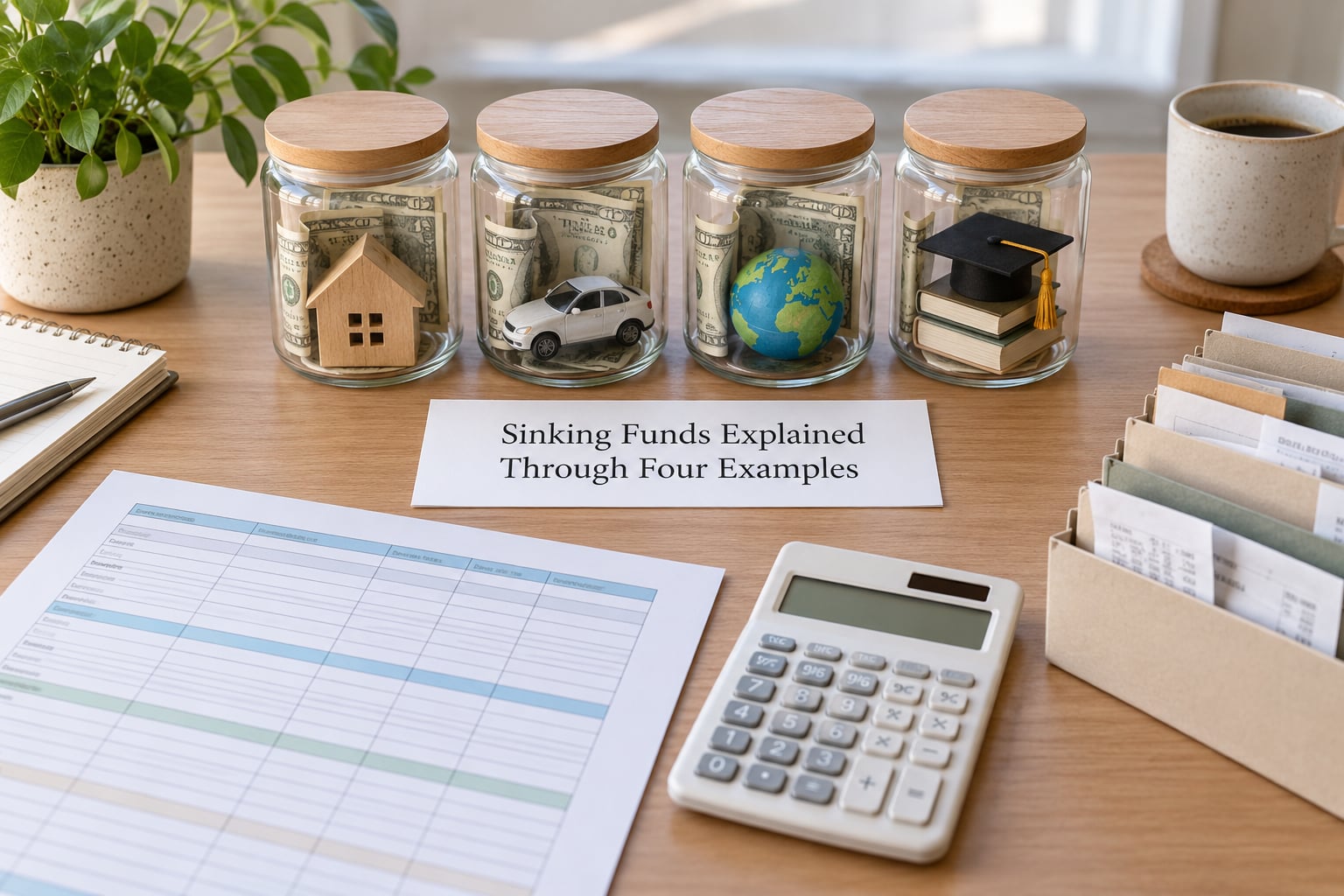
Here is what the formula produces for four ordinary household costs. Each one already has a name and a date, which is all a sinking fund needs.
| Fund | Target | Months to save | Monthly contribution |
|---|---|---|---|
| Annual car repair and tire fund | $1,200 | 12 | $100 |
| Family vacation | $3,600 | 18 | $200 |
| Wedding in two years | $15,000 | 24 | $625 |
| Laptop replacement | $1,400 | 28 | $50 |
| Total | $21,200 | — | $975 |
Car repairs and tires. This is the classic sinking fund example, and it is the hardest one because there is no invoice to quote. Pull your last twelve months of spending from your bank or card statements, add it up, and use that yearly figure as the target. Someone who spent $1,380 over the past year sets a $1,200 target with a little margin and moves $100 a month.
Vacations. Vacation sinking funds work because the date is fixed. Book the trip eighteen months out, decide what the whole thing costs including airfare and airport parking, and divide. When the money is sitting there, nobody books a vacation on a credit card in February because the balance looks low.
Weddings and other celebrations. Larger targets are where people give up. Twenty-four months is easier to swallow than twelve, and a wedding fund that reaches its target in month twenty leaves room for the extras that always appear.
Laptop and phone replacement. Set a rough replacement value and the month you would want a working device again. The fund pays for itself quietly, and you stop treating a dying battery as a reason to buy on credit at full price.
How to Calculate a Sinking Fund Contribution
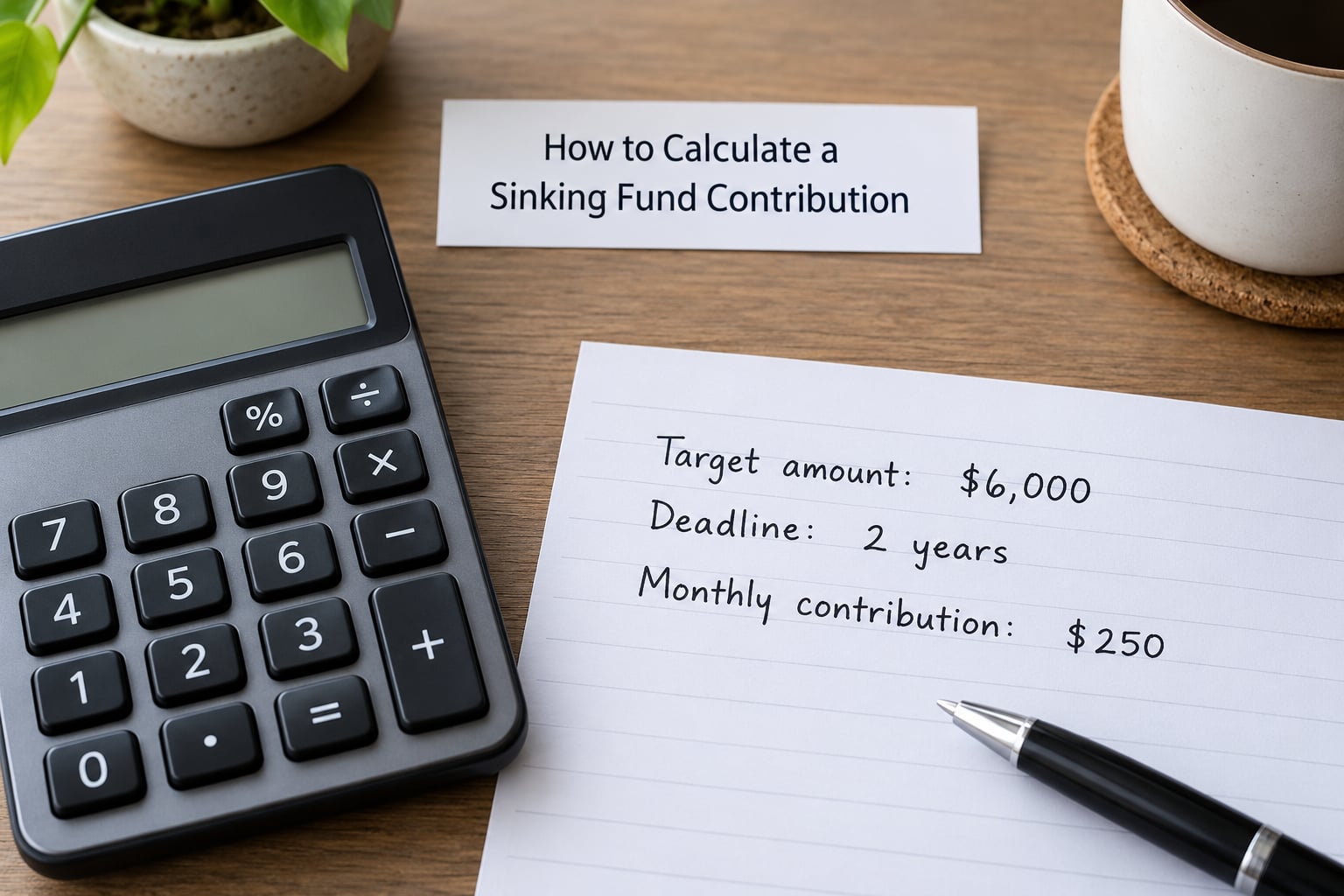
The whole calculation is one formula: target minus money already saved, divided by the months remaining. Everything else is deciding the target.
Here is the same $2,400 goal spread across five different timelines. Notice how much the deadline changes, which is why you set the date before you set the amount.
| Timeline | Monthly contribution | Total periods paid |
|---|---|---|
| 6 months | $400 | 6 |
| 12 months | $200 | 12 |
| 18 months | $133.33 | 18 |
| 24 months | $100 | 24 |
| 36 months | $66.67 | 36 |
Seven steps cover the cases that come up most often.
- Write down the expense in one line. If it takes a sentence to describe, it is not yet a fund.
- Find a real number. Check the last bill, the renewal notice, or a quote.
- If there is no clean number, average what you actually spent. Sum the last twelve months and divide by twelve for a monthly figure, then multiply by twelve for a yearly target.
- Subtract what is already in the account. This is where partial progress gets recognized.
- Count the months to the due date. Use months, not pay periods, unless you want smaller transfers.
- Divide, then round up to a number you will not miss. $133.33 becomes $135 in most households.
- Schedule the transfer for payday plus one or two days. Money that has to be moved manually gets skipped.
How much should go in sinking funds overall? There is no universal answer, but a useful sanity check is that total sinking fund contributions usually stay in the range of 5 to 15 percent of take-home pay for most households. Above that range, something is wrong, usually that you are sinking money into a large vague goal instead of a real bill.
What’s the Difference Between a Sinking Fund and an Emergency Fund?
The difference is predictability. A sinking fund covers a cost you expect; an emergency fund covers a cost you cannot predict at all.
| Sinking fund | Emergency fund | Long-term savings | |
|---|---|---|---|
| Purpose | A known future cost | An unplanned problem | A goal years away |
| Timing | Fixed date | Any time | Years |
| Target | Exact or averaged cost | Three to nine months of expenses | Based on the goal |
| How it is spent | Automatically, on schedule | Judgment call, rarely | On schedule |
| Example | Car insurance comes due in March | Transmission dies this month | House down payment |
The clearest way to see it is a worked consequence. The car insurance bill arrives, the sinking fund pays it in full, and the emergency fund stays untouched. Merge the two buckets and the first bill quietly eats your safety net.
Sizing is where people get confused. The common 3/6/9 rule suggests three months of essential expenses for a stable income, six for moderate uncertainty, and nine for variable income or a single-earner household. Those figures sit in the emergency fund, entirely separate from your sinking funds.
Two questions come up constantly in search, so here are the answers. Ten thousand dollars is not too much for an emergency fund in many situations; it is roughly six months of spending for a lot of households. Twenty thousand is high for a single earner with no dependents and low for a family with one income. What matters more than the number is whether you have kept sinking funds separate from it.
Percentage-based budget rules like the 70/10/10/10 split are a reasonable starting frame for many people, but they do not replace sinking funds. A rule tells you how much to save. A sinking fund tells you what the money is for.
Where Should You Keep a Sinking Fund?
Keep short-horizon sinking fund money somewhere stable, liquid, and separate from your daily checking. Three options cover nearly everyone.
- A high-yield savings account. The default choice. Money is available when the bill arrives, and many online banks pay a competitive rate with no monthly minimum.
- A money market account. Useful if you want a slightly higher rate with checks or a debit card, though rates and terms vary widely between institutions.
- A short-term certificate of deposit. Locking the money for six or twelve months can pay more, but you take a penalty if the bill comes due early. Only sensible for funds with a firm date far enough out.
Skip stocks, bonds, and crypto for money needed within a year. The forum consensus is blunt about this: a balanced fund that drops 15 percent in the month your car needs a transmission is a worse plan than a savings account earning a few percent.
Rates, minimum balances, and withdrawal terms change often and differ by institution, so check the current disclosure before you open anything.
Can You Use One Account for Multiple Sinking Funds?
Yes, and most people should. One high-yield savings account plus a tracking sheet is easier to maintain than fifteen sub-accounts, which is the setup people describe abandoning after a few months.
There are two ways to do it. Buckets inside one account mean you record each fund as a labeled category and track the running balance in a spreadsheet or budgeting app. Separate accounts give each fund its own statement and its own transfer, which removes any temptation to spend across funds but adds paperwork.
The spreadsheet version needs seven columns to work: fund name, target, due date, amount saved, months left, monthly contribution, and progress percentage. Once those exist, the monthly review takes two minutes.
A reasonable cap is somewhere around a dozen active funds. Past that, merge related ones, such as all subscriptions into an annual bills fund.
Common Sinking Fund Mistakes to Avoid
Setting a vague target. “Some money for the car” produces no contribution amount. Use last year’s actual spending as the number.
Saving inconsistently. A fund that only gets money in the months you feel guilty will be short every time. Automate the transfer on payday.
Using sinking fund money for emergencies. This is the fastest way to end up with nothing saved. If you raided the vacation fund for a flat tire, refill it and take the hit elsewhere.
Ignoring irregular expenses entirely. Vet bills, appliance replacements, and professional fees are all sinking fund candidates even though they are unpleasant to price out.
Investing money you need soon. Volatility right before the deadline defeats the entire purpose.
Never refilling after you spend. The fund empties and quietly stops existing, and next year the bill is an emergency again.
Over-sinking until there is no emergency fund left. Every known bill gets a fund, the balance sits idle, and one genuinely unexpected event wipes it out. A working emergency fund comes first.
Difficulty treating the money as off-limits is the most commonly reported problem, and it is mostly a naming problem. A fund called “car insurance” is easy to leave alone in a way that a generic savings account is not.
Frequently Asked Questions
Can I roll over money left in a sinking fund?
Usually yes, if the leftover reflects reality. If your Christmas fund ended with extra money because you spent less than planned, raise the next target by a sensible amount rather than letting the balance idle. If you are rolling a surplus into a different goal, close the old fund so it stops cluttering your tracker, and decide deliberately whether the new goal deserves that money at all.
Do sinking funds count as emergency funds?
No. A sinking fund is built for a cost you can name and roughly date, while an emergency fund covers what you cannot predict. If the two are combined, the predictable bill spends the safety net first. Keep them in separate buckets even if they sit at the same bank, and size the emergency fund against three to nine months of essential expenses.
Should sinking-fund money be invested for higher returns?
Only when the deadline is far enough away to absorb a bad market year. Money needed within twelve months belongs in a savings account, money market account, or short-term certificate of deposit where the balance is stable and available. Investing money you need next spring exposes you exactly when the expense lands, and a 15 percent drop wipes out years of contributions.
Can I withdraw from a sinking fund early?
You can, but treat it as a deliberate choice rather than a shortcut. Moving vacation money to cover a car repair changes your plan, so put the vacation fund on a slower refill schedule afterward and adjust the date if the money will not be there in time. Constant raids are the reason some people stop using sinking funds at all.
What happens to a sinking fund if I no longer need the planned expense?
Close it and give the money a new job. You might cancel the subscription you were funding, skip a trip, or sell the car you were replacing, and suddenly the balance is free. Move it to another goal you actually care about, or put it toward your emergency fund if that is underfunded. Leaving empty categories in your tracker just creates clutter.
Conclusion
A sinking fund is a named amount of money, a date, and a monthly transfer that runs on autopilot. Start with one predictable expense you already know is coming, set a realistic target, and open a clearly labeled place to keep it today.
This is general information about budgeting, not financial advice. Rules, rates, and account terms vary by state and institution and change over time.