
To open a savings account for a child, you apply online or at a branch for a youth savings or joint account using the child’s Social Security number, your own ID and address, then fund it with an opening deposit. Most online applications take about 15 minutes, and many set the minimum opening deposit at zero.
The paperwork is the easy part. The decision people regret is picking the wrong kind of account, because a joint youth savings account and a custodial account look nearly identical on the application screen and behave very differently once your child turns 18.
I have walked a few families through this and the same three questions keep coming up: who legally owns the money, what does the institution charge, and what happens to the balance on the eighteenth birthday. Answer those three and the rest is filling in fields.
Table of Contents
- What You Need
- How to Open a Savings Account for a Child
- Step 1: Choose the Account Type
- Step 2: Compare Fees, Minimums, and Interest
- Step 3: Gather the Child’s Information
- Step 4: Open the Account Online or at a Branch
- Step 5: Fund the Account and Set Up Access
- Step 6: Confirm Ownership, Records, and Tax Details
- Common Mistakes
- Tips for Building a Healthy Savings Habit
- Frequently Asked Questions
- Is it better to put money in a 529 plan or a savings account for my child?
- What type of savings account should I open for my child?
- Do parents pay taxes on a custodial account for their child?
- What happens to a custodial account when my child turns 18?
- Does a child savings account affect financial aid?
- Can I open a savings account before my child has a Social Security number?
- Start With One Account and a Small Deposit
What You Need
Banks are strict about identity checks for good regulatory reasons, and they are strict about names. Have the following ready before you start, and most applications take a single sitting.
- The child’s full legal name exactly as it appears on the birth certificate
- The child’s date of birth and Social Security number
- Your government-issued photo ID, usually a driver’s license or passport
- Your own Social Security number
- Your residential address, and the child’s residential address
- An email address and a phone number the bank can use to verify you
- An opening deposit, which is often zero online and rarely more than a small amount at a branch
- Your taxpayer ID or the child’s, if you are opening the account in the child’s name
You also need to make a few decisions before you look at any bank. Who will be on the account title, what type of account you want, whether you will fund it monthly or in lumps, and how much of the money the child is allowed to touch.
If your child has no Social Security number yet, which is common with newborns, there is a workaround a few steps down. Do not skip to the end of the article assuming you have to wait.
How to Open a Savings Account for a Child
The process runs in six steps: choose the account type, compare fees and rates, gather documents, apply online or in person, fund the account and set access, then confirm the ownership and tax paperwork. The first step decides everything that follows.
Step 1: Choose the Account Type
There are two real bank options, and everything else is an investment account you can add later.
A joint youth savings account puts your name and your child’s name on the same account. Either of you can deposit or withdraw, the money legally stays yours, and most youth accounts convert to an individual account automatically on the child’s eighteenth birthday. This is the simplest starting point and the one most families use.
A custodial account, opened under the Uniform Gifts to Minors Act or the Uniform Transfers to Minors Act, has one owner: the child. You act as custodian and control every withdrawal until your child reaches the age of majority, which is 18 in most states and as high as 21 in a few. The money is irrevocably the child’s once it goes in.
| Account type | Who controls the money | At age 18 | Best for |
|---|---|---|---|
| Joint youth savings | Parent and child, both signers | Converts to the child’s individual account, balance is theirs | Allowance, birthday checks, spending money |
| Custodial UGMA or UTMA | Parent as custodian only | Child gets the money outright and can use it for anything | Investing a child’s gifts and inheritance |
| 529 plan | Parent or other chosen owner | Child becomes the beneficiary and controls the money | College and qualified education costs |
| Coverdell ESA | Parent as designated custodian | Child controls the account at 18 | Private school and K-12 education expenses |
| Custodial Roth IRA | Parent as custodian | Child owns it, opens their own Roth at 18 | Long-term investing once the child has earned income |
Many parents end up with two accounts on purpose, and parent forums converge on the same split every time: a plain savings account for money the child may spend one day, and a 529 for education-only money. You can open the savings account today and add the 529 later.
Step 2: Compare Fees, Minimums, and Interest
Compare these five lines for every candidate, including the local credit union down the street, not just the online banks:
- Monthly maintenance fee. Aim for zero. A 5 dollar monthly fee quietly costs 60 dollars a year on a small balance.
- Minimum opening deposit. Many online youth accounts set this at zero, which is a real advantage when you are starting small.
- Minimum balance required to avoid a fee. This is the line that surprises people, because it can be higher than the deposit you planned to make.
- Annual percentage yield, or APY. This is what you actually earn after fees, stated as a percentage.
- ATM and overdraft terms. Out-of-network ATM fees add up, and a youth account with a debit card can go negative without overdraft protection.
Check how the deposits are insured. Accounts at FDIC-insured banks and NCUA-insured credit unions are covered; some online accounts hold your balance at a partner bank and route it through a network.
Rates move, so do not rely on a roundup article for numbers. Read the APY on the institution’s own disclosure page the same day you apply.
As a plain illustration of why the minimum balance line matters: 10,000 dollars sitting at an example 4 percent APY earns about 400 dollars over a year before tax, while the same 10,000 dollars at half a percent earns about 50. That gap is larger than most monthly fees will ever cost you.
Step 3: Gather the Child’s Information
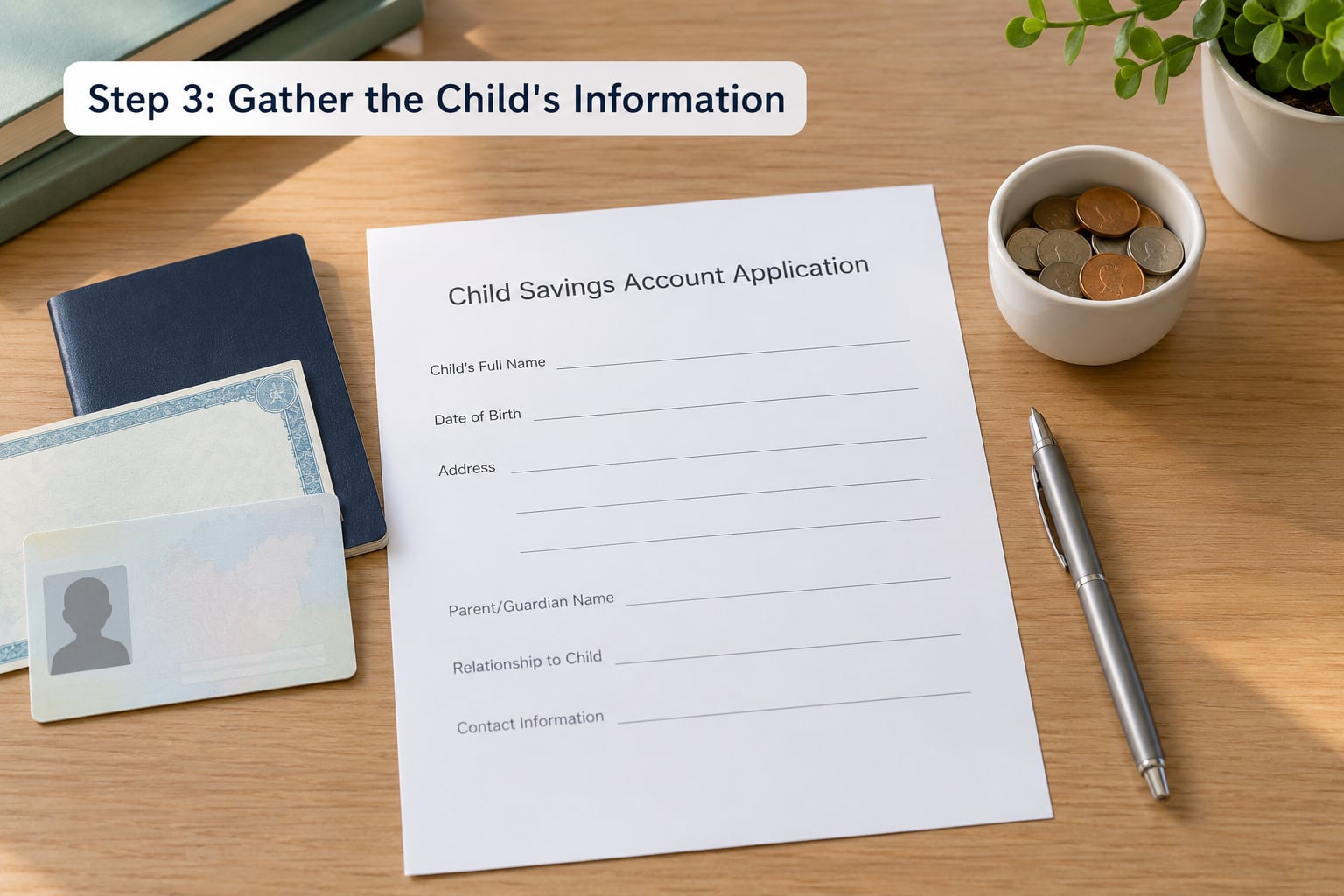
Every institution asks for some variation of the same list: the child’s legal name, date of birth, address, and Social Security number, plus your own ID and address. Some ask for a birth certificate, and most do not, but having a copy avoids a second trip.
Type names exactly as the birth certificate spells them. A mismatch between the application and the Social Security record is one of the most common reasons an application gets rejected or an account gets frozen later.
If the child has no Social Security number yet, you have three options: apply for one through the Social Security Administration, open the account in your own name as a holding account and transfer the money into the child’s account once the number arrives, or wait a few months. Plenty of parents do the second option and it works fine.
Step 4: Open the Account Online or at a Branch

Online applications are faster and usually come with no monthly fee, no minimum opening deposit and a competitive rate. If the child already has a Social Security number, this is the easy path. You will enter both sets of information, confirm your identity with a phone or email code, choose the account type, and pick the opening deposit amount.
A branch is better when you want a paper account, a handwritten passbook-style record for a young child, a coin deposit, or a person to explain the terms in person. Bring the same documents, and expect the banker to walk through the account agreement with you rather than handing you a link.
Before you submit either way, read the account disclosure. Check the fee schedule, the minimum balance, the rate, the overdraft policy, and the title format. This is the last easy moment to fix a mistake without paperwork.
How to open a savings account for a child comes down to who signs and what the title says, so this is the step worth slowing down on. A title written in the wrong order, or with a middle name that does not match the tax record, creates problems that surface years later.
Step 5: Fund the Account and Set Up Access
Make the opening deposit from your own account by ACH transfer, or deposit cash or a check at a branch or through mobile deposit. Set up an automatic transfer for whatever amount fits your month, even if it is small, because a habit you keep beats a lump you make once.
Then configure access deliberately. Choose a debit card only if the account is a checking or youth account, set spending limits and alerts, turn on paperless statements, and decide when the child gets their own login.
A common pattern that works well: the parent holds full access up to about age 12, the child gets view-only access at 12 and deposit access at 16, and the child takes full control at 18. That is a teaching ladder, not a legal rule.
For teenagers with earned income, ask the bank whether the account supports direct deposit for a first job. Parents consistently say the moment a child watches a paycheck land in an account is the money lesson that sticks.
Step 6: Confirm Ownership, Records, and Tax Details
Before you call it done, verify the account title reads exactly as you intended, and note down the account number and the institution’s customer service line somewhere other than the account itself.
On taxes, understand the basics rather than worrying about them. Interest is reported to the IRS on Form 1099-INT and is generally reported on the child’s return, or on yours if the child is young enough to be claimed as a dependent, which is what people call the kiddie tax.
Contributions to a UGMA or UTMA are treated as annual gifts, and gift tax rules can be surprising, so check current limits with a tax professional before making a large deposit in one year. Contributions to a 529 are completed gifts to the beneficiary rather than to you, and many plans allow five years of contributions up front before the annual limit resets.
Finally, check whether the account has a beneficiary designation and whether the institution holds unclaimed or dormant account balances for minors. It is a small step that prevents a large headache later.
Common Mistakes
Opening a custodial account when you meant a savings account. A UTMA or UGMA locks you into investing, cannot be renamed, and hands the child every dollar at 18 whether or not they are ready. If you want a teaching tool with cash in it, open a joint youth savings account instead.
Choosing the account on the interest rate alone. A high APY is meaningless if the account charges a fee below a balance you plan to maintain. Read the fee schedule first, then the rate.
Ignoring the insurance line. Confirm the institution or its partner bank is FDIC or NCUA insured before you deposit.
Filling in the child’s name from memory. A single wrong letter in a middle name can hold up verification for weeks. Copy from the birth certificate.
Skipping the tax and gift conversation. Families routinely panic that they will owe gift tax on a contribution to a custodial account. The answer depends on current law and the size of the gift, so read the current IRS guidance rather than forum posts.
Letting the account go dormant. Small balances in old accounts are routinely unclaimed. A tiny automatic transfer keeps the account active and visible.
Tips for Building a Healthy Savings Habit
Set up one automatic deposit that comes out the day after payday, so the saving happens before the month gets tight. Then add a simple parent match: for every 5 dollars your child puts in, you add 1. Matching works far better than nagging.
Give the account one job at a time. A single named goal, like a 200 dollar bike fund, teaches more than a vague instruction to save more, because the child can watch a number move toward a target.
Let your child make deposits with their own hands, even if you set up the transfer. Parents point to that moment as the single best teaching win of the whole exercise.
Review the balance a few times a year rather than daily, and resist raising the target every time the child spends from it. Keep emergency money for a teenager in a separate account from long-term money, since an account everyone knows about is an account that gets raided.
Frequently Asked Questions
Is it better to put money in a 529 plan or a savings account for my child?
Usually both, for different jobs. A plain savings account holds money your child may spend one day, such as allowance savings, a car fund or birthday checks. A 529 is for qualified education expenses and earns tax-free, but the money is not the child’s to spend freely, and the plan has contribution limits and rules that reset on a schedule. Parents on finance forums converge on the same split.
What type of savings account should I open for my child?
A joint youth savings account is the simplest starting point. You and the child share access, the balance stays yours legally, and most institutions convert it to the child’s individual account on their eighteenth birthday. Look for no monthly maintenance fee, no minimum opening deposit, and no minimum balance requirement that you would miss.
Do parents pay taxes on a custodial account for their child?
Interest earned in the account is reported to the IRS on Form 1099-INT and is usually reported on the child’s return, or on the parent’s return when the child is a dependent, which families call the kiddie tax. Contributions to a UGMA or UTMA are treated as annual gifts. Gift tax treatment depends on current law and the size of the gift, so check the current IRS guidance before a large deposit.
What happens to a custodial account when my child turns 18?
Control passes to your child and the money becomes theirs outright, to spend on anything. The age of majority is 18 in most states but as high as 21 in a few, so check your state’s rule. A 529 is different: your child becomes the beneficiary and gains control of the money without taking it out early, and withdrawals are limited to qualified education expenses.
Does a child savings account affect financial aid?
A joint youth savings account in your child’s name is usually an uncounted asset for federal aid purposes, because it is treated as the child’s own money. A 529 you own is assessed differently, and students can face a limited income contribution calculated from the balance under the current FAFSA formula. Financial aid rules change, so verify the current treatment before you rely on a specific number.
Can I open a savings account before my child has a Social Security number?
Most banks require one to open an account in a child’s name. If your newborn does not have a number yet, apply through the Social Security Administration, open the account in your own name as a holding account, or wait until the number arrives. Opening it in your own name and transferring the money later is a common approach that costs nothing but a little paperwork.
Start With One Account and a Small Deposit
If you do one thing this week, pick two institutions, compare the fee schedule and minimum balance on each, and open the youth savings account with an amount you will not miss. Add the child’s name, set one automatic transfer, and let the balance teach the rest.