Federal vs private student loans come down to one default rule: borrow the maximum your federal eligibility allows first, then cover only the remaining gap with a private loan. Federal loans carry fixed rates plus borrower protections such as income-driven repayment and forgiveness. Private loans can be cheaper for your credit profile, but the protections mostly disappear.
That ordering is not always optimal. A physician heading into a high-income specialty has little use for loan forgiveness, so the extra cost of federal borrowing is real money spent on insurance they will never claim. The rest of this guide breaks down where each loan type wins, where it costs you, and how to work out which one fits your situation.
Rate figures below are illustrative examples drawn from published program structures, not quotes. Federal rates reset every July, so confirm the current number on studentaid.gov before you sign anything.
Table of Contents
- Federal vs Private Student Loans at a Glance
- Interest Rates and Borrowing Costs
- Federal rates are one number for everyone, set once a year
- Private rates vary with your credit, and the best offer is not always the cheapest loan
- Repayment Plans and Payment Flexibility
- Forgiveness, Deferment, and Discharge Options
- Credit Checks, Eligibility, and Access
- Federal loans mostly skip the credit check, and that myth confuses plenty of borrowers
- Which Should You Choose?
- Frequently Asked Questions
- Are private student loans cheaper than federal student loans?
- How much would a 30,000 dollar student loan be monthly?
- How much is the monthly payment on a 70,000 dollar student loan?
- How much would I pay per month on a 100,000 dollar student loan?
- Do private student loans qualify for loan forgiveness?
- Can I combine federal and private student loans?
- Conclusion
Federal vs Private Student Loans at a Glance
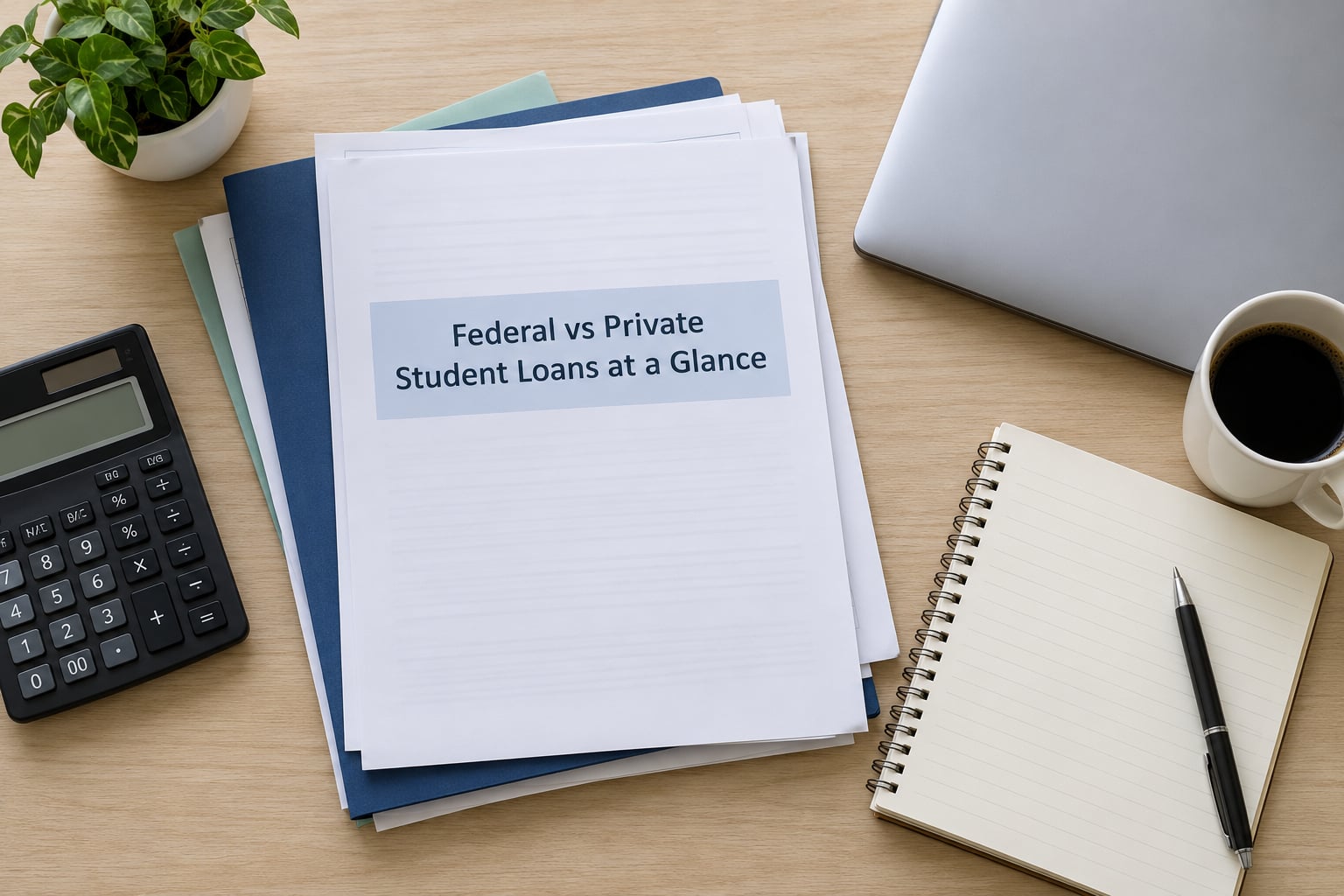
This is the shortest version of the comparison. Federal loans are issued by the U.S. Department of Education under one set of rules for everyone. Private loans are issued by banks, credit unions and state-based lenders that set their own terms after looking at your credit file.
| Factor | Federal student loans | Private student loans |
|---|---|---|
| Who issues it | U.S. Department of Education, served by contracted servicers | Banks, credit unions, online lenders, state agencies |
| How you apply | FAFSA, then your school’s financial aid office | Direct application to the lender, usually with a cosigner |
| Credit check | Not required for Direct Subsidized or Unsubsidized; a soft inquiry for aid; a hard check for PLUS | Hard credit check and full underwriting, with or without a cosigner |
| Interest rate type | Fixed for the life of the loan | Fixed or variable, depending on the product |
| How the rate is set | Congress sets one rate each July for every borrower | The lender prices your rate from your credit profile, credit history, school and chosen term |
| Annual borrowing limit | Set by law against your cost of attendance, with a lifetime aggregate cap | Set by underwriting, usually tied to the school’s reported cost of attendance |
| Upfront fee | Origination fee deducted before the money reaches you | Origination fee, or none at all, plus late fees under the loan terms |
| Deferment and forbearance | Both available, deferment for qualifying situations | Hardship programs offered at the lender’s discretion |
| Income-driven repayment | Several plans tied to your income and family size | None. Standard or fixed-term amortization only |
| Forgiveness | Public Service Loan Forgiveness, closed-school relief, total and permanent disability discharge | None, except rare death or disability clauses written into the note |
| Cosigner | Not required. Parent PLUS makes the parent the borrower | Required for the large majority of undergraduate borrowers |
| If you miss payments | Administrative collection, no statute of limitations, benefit offsets | Judicial collection with a statute of limitations, wage garnishment after a judgment, possible asset seizure |
Interest Rates and Borrowing Costs
Federal rates are one number for everyone, set once a year
Congress sets undergraduate and graduate Direct Loan rates each July, and borrowers locked in at disbursement keep that rate for the life of the loan. That sameness cuts both ways. You cannot earn a better rate than your classmate with an identical degree, and you cannot be penalized either. Direct Subsidized and Direct Unsubsidized Loans normally carry the lowest federal fixed rates. PLUS Loans carry a higher rate because the government guarantees them without underwriting, and you can lose that guarantee for a credit-related event.
The other federal cost is the origination fee, withheld from your disbursement. It is a percentage of the loan rather than a fixed charge, which is why it stings more on a large balance. A borrowing-limit check matters here too: federal annual limits are calculated against your school’s cost of attendance, so a student attending a lower-cost program may hit the cap with money left on the table.
Private rates vary with your credit, and the best offer is not always the cheapest loan
Private lenders price against your credit score, your credit history, your school’s top ranking and the term you pick. Undergraduates with a thin credit file usually see double-digit quotes or get refused without a cosigner. Borrowers with strong credit and a steady payment history get the best rates. The rate can also reset after graduation if you picked a variable product, which is the single detail that has ruined more payment plans than any other.
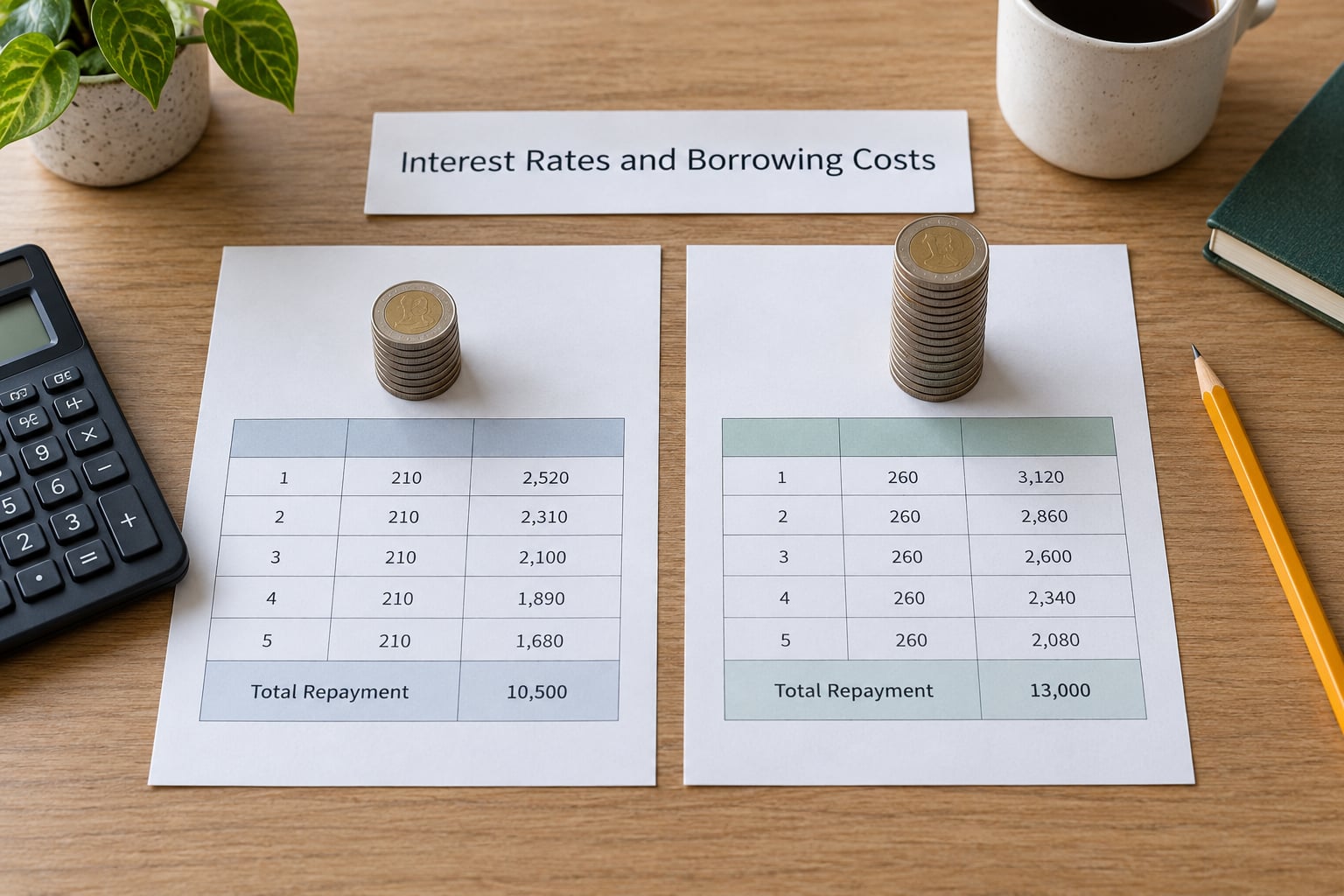
Here is what the numbers do at three balances, using sample rates rather than live quotes. Payments are standard ten-year amortization with monthly compounding.
| Balance | At 6.28 percent | At 6.50 percent | At 7.00 percent (PLUS-style) | At 4.99 percent (private-style) |
|---|---|---|---|---|
| USD 30,000 | About 337 per month, roughly 10,500 in interest | About 341 per month, roughly 10,900 in interest | About 348 per month, roughly 11,800 in interest | About 318 per month, roughly 8,200 in interest |
| USD 70,000 | About 787 per month, roughly 24,400 in interest | About 795 per month, roughly 25,400 in interest | About 813 per month, roughly 27,600 in interest | About 742 per month, roughly 19,000 in interest |
| USD 100,000 | About 1,124 per month, roughly 34,900 in interest | About 1,136 per month, roughly 36,300 in interest | About 1,161 per month, roughly 39,300 in interest | About 1,060 per month, roughly 27,200 in interest |
On a 70,000 balance over ten years, the gap between a 6.28 percent federal rate and a 4.99 percent private rate is roughly 5,400 in total interest. That is a meaningful number, and it is the entire financial argument for private borrowing. Now hold it against a 5,500 monthly income: a federal borrower on an income-driven plan might pay under 200 a month and clear the balance in fifteen years, while the private borrower pays the full 742.
The lowest monthly payment is not the lowest cost. Private lenders often advertise a small payment by extending the term to fifteen or twenty years, which lowers the monthly figure and raises the total. Check the total repayment figure, not the monthly one, before you commit.
Repayment Plans and Payment Flexibility
Federal borrowers start on the standard ten-year plan, and the repayment date is usually fixed. Income-driven plans recalculate your payment from your taxable income and family size each year, so a bad year or a raise can genuinely lower what you owe. That recalculation is the flexibility private lenders cannot match, because they have no way to verify your income on an annual basis the way the federal government can.
Federal borrowers can also request extended or graduated terms, refinance a federal loan into a new Direct Consolidation Loan, or shift into a different income-driven plan if their situation changes. Each of those has trade-offs worth reading about first, particularly the consolidation route.
Private loans follow a fixed amortization schedule. Some issuers offer short interest-only periods or graduated payments, and nearly all will discuss refinancing, a new credit check and, when a cosigner was used, a cosigner release after a set number of payments. What you will not find is a payment that moves with your paycheck.
When you hold both types, extra dollars go to the private balance first in most cases. It accrues interest immediately with no deferment safety net behind it, and it has no forgiveness tail to protect. Borrowers on the r/StudentLoans forum repeatedly describe this same ordering in practice.
Forgiveness, Deferment, and Discharge Options
Public Service Loan Forgiveness is the benefit that changes decisions most, and it is federal only. It requires eligible Direct Loans, a qualifying employer such as a government agency or non-profit, and a long enough stretch of qualifying payments. Borrowers reach it through an employment certification form filed with the servicer, and the clock runs on certified employment, not on calendar time. Borrowers who quit qualifying work partway through often have their counted payments thrown out, which is why annual certification matters.
Deferment pauses payments for defined situations such as enrolment or military service, and for some borrowers it also pauses interest. Forbearance is the looser version: it pauses or reduces payments in financial hardship, and interest keeps accruing on many plans. When you are choosing between the two, ask which one your situation actually qualifies for rather than assuming they are interchangeable.
Discharge handles the harder cases. Federal rules provide relief for death, total and permanent disability, and closed-school fraud. Bankruptcy is a genuine release for federal student debt, which is unusual and is the reason so many borrowers keep federal loans rather than refinance. Private lenders honour the same death and disability clauses, and some refinance borrowers find bankruptcy relief as well, but the terms vary and a cosigner can still owe the balance after you are discharged.
Credit Checks, Eligibility, and Access
Federal loans mostly skip the credit check, and that myth confuses plenty of borrowers
Direct Subsidized and Direct Unsubsidized Loans do not require a credit check. One common misconception on financial forums is that every federal loan pulls your credit, but that is not the case. Parent PLUS and Grad PLUS are different: the Department of Education runs an adverse credit history review, and any credit-related event in your file can suspend the guarantee until you document the circumstances. There is also a soft credit inquiry when financial aid is offered and you accept it.
Private lenders run hard inquiries and full underwriting, which means your debt-to-income ratio, payment history and credit score all feed the rate. Most lenders require a credit score in the mid-600s or higher, and a large share of undergraduate private borrowers cannot qualify without a cosigner. That cosigner is fully liable, and a late payment hurts their credit too.
Federal eligibility runs through the FAFSA and your school’s financial aid office, including grants and work-study that reduce the amount you need to borrow. A surprising number of borrowers take private money before checking whether they qualified for aid they never applied for.
Which Should You Choose?
Start by exhausting the federal side, then measure what is left. Work through these steps in order.
- File the FAFSA and accept every grant and work-study offer first. Free money reduces the balance before you borrow anything.
- Borrow the maximum Direct Subsidized and Direct Unsubsidized Loans your program allows, within the annual and aggregate limits.
- If you are still short, work out whether an income-driven plan would actually lower your payment. If it would, borrowing privately instead means giving that option up permanently.
- Apply to private lenders only for the remaining gap, and treat it as the last dollar of the cost of attendance.
- Compare the total repayment figure, not the monthly one, and prefer a fixed rate over a variable one.
- After graduation, consider refinancing the private balance only if the new rate saves more than the fee. Leave the federal balance alone unless you are confident you will never want forgiveness.
Profile by profile, the answer shifts. Undergraduates should go federal first almost without exception, because their borrowing is smaller and the protections matter most early. Graduate and doctoral students who expect high earnings in a field like medicine, law or finance often benefit more from a lower private rate, because forgiveness will never move them to a lower payment. Parents comparing Parent PLUS against a private parent loan should look at the rate gap over the full term and at whether the family might need deferment. Borrowers on a public-service career path should treat forgiveness as the deciding factor rather than the rate.
One case deserves extra caution: refinancing a federal balance into a private loan to chase a lower rate. It is reversible only by taking on new debt, and if your income later falls, you will have given up the income-driven option that could have handled it.
Frequently Asked Questions
Are private student loans cheaper than federal student loans?
Sometimes. A private lender that prices your credit profile favorably can quote a fixed rate below the current federal Direct Loan rate, which saves real money over ten years. The gap is smaller for borrowers with thin credit and larger for strong ones, and private rates can rise if you choose a variable product. Compare total repayment over the full term rather than the monthly payment, and add any origination fee before deciding.
How much would a 30,000 dollar student loan be monthly?
On a standard ten-year federal repayment plan, 30,000 dollars works out to roughly 337 a month at a 6.28 percent rate and roughly 341 a month at 6.50 percent. A typical private rate of 4.99 percent brings it near 318 a month. Total interest ranges from about 8,200 over ten years at the lower private rate to about 10,900 at the higher federal rate.
How much is the monthly payment on a 70,000 dollar student loan?
A 70,000 dollar balance over ten years runs about 787 a month at 6.28 percent, about 795 at 6.50 percent, and about 813 at a 7 percent PLUS-style rate. At a private rate of 4.99 percent it drops near 742 a month and total interest falls to roughly 19,000 from about 24,400 to 25,400. Federal rates reset each July, so verify the current figure.
How much would I pay per month on a 100,000 dollar student loan?
At 100,000 dollars over ten years, expect roughly 1,124 a month at 6.28 percent, 1,136 at 6.50 percent and 1,161 at a 7 percent rate. A 4.99 percent private rate lands near 1,060 a month, saving about 27,200 in interest compared with roughly 36,300 at 6.50 percent. Balances this size usually involve graduate, medical or Parent PLUS borrowing, where the rate gap matters most.
Do private student loans qualify for loan forgiveness?
No. Public Service Loan Forgiveness and the federal income-driven plans cover Direct Loans only, which is the most common misconception borrowers run into. Private lenders do offer hardship forbearance and occasional death or disability clauses, and cosigner release programs reduce someone else’s liability, but none of those forgive your balance the way a federal program can. Borrowers with a genuine forgiveness plan should keep that money federal.
Can I combine federal and private student loans?
You can hold both at once, and plenty of families end up with a mixed portfolio after graduation. You cannot combine them into a single federal loan, because private balances are not eligible for a Direct Consolidation Loan. The usual strategy is to keep paying minimums on the federal side and direct extra money at the private balance first, since it accrues interest immediately with no deferment safety net.
Conclusion
Federal vs private student loans is not a contest with one winner. Federal borrowing is cheaper in flexibility and cheaper in risk, and it is the only path to forgiveness. Private borrowing is cheaper in raw interest for the borrowers whose credit earns a lower rate and whose income makes repayment plans irrelevant.
Three things to do this week. File or check your FAFSA status and accept every grant on offer. Run your actual balance through a ten-year amortization at the current federal rate on studentaid.gov and at your real private quotes, then compare total interest rather than the monthly payment. And before you sign anything private, decide honestly whether you will ever use deferment or forgiveness, because that answer decides the whole comparison.
Programs and rates change every year, so treat the figures here as a working model and verify the current ones with the U.S. Department of Education and your lender before you commit.