
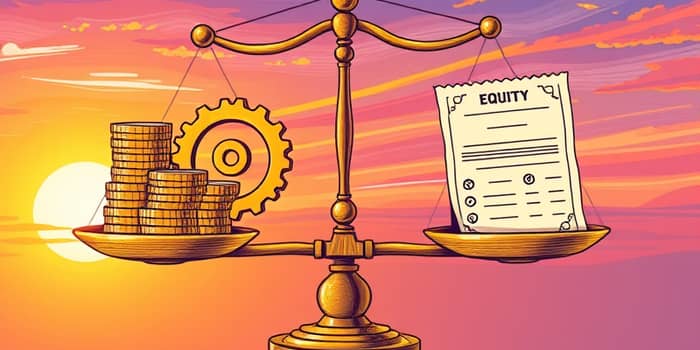
In the journey of building or expanding a business, choosing between debt and equity financing is a pivotal decision that shapes your future.
These choices impact ownership, cash flow, and risk tolerances, influencing not just your bottom line but also your strategic direction.
Core Concepts of Financing Choices
Debt financing involves borrowing capital with fixed repayment obligations, commonly through loans, bonds, or lines of credit. It allows businesses to retain full ownership without dilution and maintain complete control over strategic decisions.
Equity financing, on the other hand, raises funds by selling ownership stakes to investors. There are no mandatory repayments, but you share profits and potentially cede some decision-making power.
Key Factors in Choosing Your Financing Mix
Every business must weigh a series of fundamental factors when deciding between debt and equity. These include ownership structure, repayment terms, cost of capital, risk distribution, and strategic value.
Scenarios and Numerical Illustrations
Real-world examples help clarify the trade-offs:
Scenario A allocates 70% debt and 30% equity. Monthly debt payments amount to $42,000, while you retain 70% equity ownership. You face substantial cash flow pressure every month but benefit from lower overall cost of capital, at around 8.5%, albeit with higher default risk.
Scenario B flips the ratio to 30% debt and 70% equity. Debt payments fall to $18,000 monthly, ownership drops to 30%, and you enjoy greater flexibility in reinvesting profits. The cost of capital rises to roughly 12%, but your risk profile improves considerably.
Finding the Optimal Balance
No single ratio fits every company. The goal is to minimize your weighted average cost of capital (WACC) by balancing the tax benefits of debt against the flexibility and added expense of equity.
- Monitor your current WACC curve to identify the lowest point.
- Gradually adjust debt levels to avoid sudden spikes in leverage risk.
- Engage financial advisors to evaluate market conditions and credit costs.
When to Favor Debt and When to Seek Equity
Debt financing is ideal when your business has stable, predictable cash flows and you want to preserve full ownership. Companies with strong credit ratings benefit most from the tax-deductible interest expense advantage.
Equity financing shines during high-growth or early-stage phases when revenue is unpredictable. By sharing risk with investors, you gain not only capital but also access to valuable expertise and networks that can accelerate your expansion.
Practical Steps to Structure Your Capital
Applying these insights requires a clear, disciplined approach:
- Assess your cash flow projections over a multi-year horizon to estimate repayment capacity.
- Calculate your current cost of debt and expected equity returns to model different capital mixes.
- Review investor terms carefully to ensure alignment with your long-term vision.
- Build flexibility into your financing by including covenants or repayment holidays.
- Plan for exit scenarios, whether via sale, IPO, or refinancing, to align investor expectations.
By following these steps, you create a resilient capital structure that adapts to both opportunities and challenges.
Long-Term Strategic Considerations
Over time, the optimal financing mix may shift. As your venture matures, you might refinance short-term debt with longer maturities or pursue mezzanine financing to bridge debt and equity characteristics.
Continuously revisit your strategy as market conditions, interest rates, and growth objectives evolve. A well-structured capital plan not only supports day-to-day operations but also positions you for strategic acquisitions, technological investments, or global expansion.
Conclusion
Understanding the trade-offs between debt and equity financing empowers you to craft a capital structure that aligns with your vision and risk tolerance. By strategically blending these options, you can harness the benefits of low-cost borrowing, shared risk with partners, and sustained ownership control.
Embrace the insights in this article to confidently navigate financing decisions, unlock growth potential, and steer your enterprise toward lasting success.
References
- https://www.lucid.now/blog/capital-structure-scenarios-debt-vs-equity/
- https://www.trevipay.com/resource-center/blog/what-is-the-difference-between-debt-financing-and-equity-financing-for-businesses/
- https://www.pnc.com/insights/small-business/manage-business-finances/debt-financing-vs-equity-financing-a-comprehensive-guide.html
- https://growthlending.com/knowledge-bank/the-difference-between-debt-financing-and-equity-financing
- https://breakingintowallstreet.com/kb/debt-equity/debt-vs-equity-analysis/
- https://ca.indeed.com/career-advice/career-development/debt-vs-equity
- https://corporatefinanceinstitute.com/resources/commercial-lending/debt-vs-equity/
- https://redcliffetraining.com/blog/equity-financing-vs-debt-financing
- https://www.hubspot.com/startups/fundraising/equity-vs-debt-financing
- https://www.business.com/articles/debt-vs-equity-financing/
- https://www.schwab.com/learn/story/what-are-different-types-investment-securities
- https://www.mccrackenalliance.com/blog/what-is-the-difference-between-debt-financing-and-equity-financing
- https://www.thehartford.com/business-insurance/strategy/startup-financing/debt-vs-equity
- https://developmentbank.wales/resources/learning-hub/funding/what-difference-between-equity-and-debt
- https://themaineaquaculturist.org/essential-start-guide-maine-aquaculture/investment-equity-debt/