
Net worth is everything you own minus everything you owe. To figure out how to calculate net worth, you total your assets at current value, total your liabilities at the balance you still owe, and subtract one from the other — then repeat the process on the same date each month or quarter so the changes mean something.
The formula itself takes five seconds. The part people get wrong is the inputs: using the purchase price instead of today’s value, forgetting a debt, or mixing statement dates so two numbers are a month apart. A working setup takes about 20 minutes per update once you have done it twice.
Everything below assumes US household accounts — checking and savings, employer retirement plans, IRAs, mortgages, auto loans, student loans and credit cards — as of 2026. Rules and account names differ by country and by state, so treat this as a way to organize your own numbers, not as financial advice.
Table of Contents
- What You Need Before You Start
- Step-by-Step: How to Calculate and Track Your Net Worth
- Step 1: Set a Consistent Cutoff Date
- Step 2: List Every Asset You Own
- Step 3: List Every Liability You Owe
- Step 4: Calculate Total Assets and Total Liabilities
- Step 5: Separate What Counts From What Does Not
- Step 6: Save a Baseline Snapshot
- Step 7: Update It on a Regular Schedule
- Step 8: Track Net Worth Trends Instead of One Number
- Common Mistakes to Avoid
- Tips for Keeping Your Net Worth Organized
- Frequently Asked Questions
- What is the formula for calculating net worth?
- How do I track my net worth in Google Sheets?
- Should I include my home and my car in net worth?
- How often should I calculate my net worth?
- Can net worth be negative?
- Is 500,000 a good net worth?
- Start With One Number, One Date
What You Need Before You Start

You need four things: statements for a single date, balances for every debt, current values for anything that is not a bank account, and one place to record the result. That last item matters more than people expect.
Statements for the same date. Pull the most recent statement or screen for every account you own and every account you owe. If two accounts are dated differently, use the statement closest to your cutoff date and note the difference rather than hunting for an older statement.
Balances for every debt. Credit card balances, the remaining balance on your student loans, your auto loan, mortgage balance, personal loans, any buy-now-pay-later balance and any unpaid medical bills. The number you need is what you still owe, not what you originally borrowed.
Current values for property and vehicles. For a home, use recent comparable sales in your area rather than an online estimate. For a car, use a guide value such as a private-party guide rather than a dealer trade-in number, because the trade-in figure is what somebody will pay you, not what the car is worth.
Retirement accounts at market value. Employer plans, traditional and Roth IRAs, and any state retirement system all count at the balance shown on the cutoff date. That is the pre-tax balance. You do not subtract estimated future taxes, because most people will not pay taxes on all of it.
A tracking method you will actually keep. That can be a spreadsheet you build yourself, a budgeting app that already reports net worth, or a dedicated tracker. Whatever you pick, the format matters less than using the same one every time.
A way to handle missing records. If a statement is unavailable, use the last known balance and mark it as estimated in a note column. Do not leave a row blank — a blank row quietly shrinks your total, and you will not remember why six months later.
Step-by-Step: How to Calculate and Track Your Net Worth
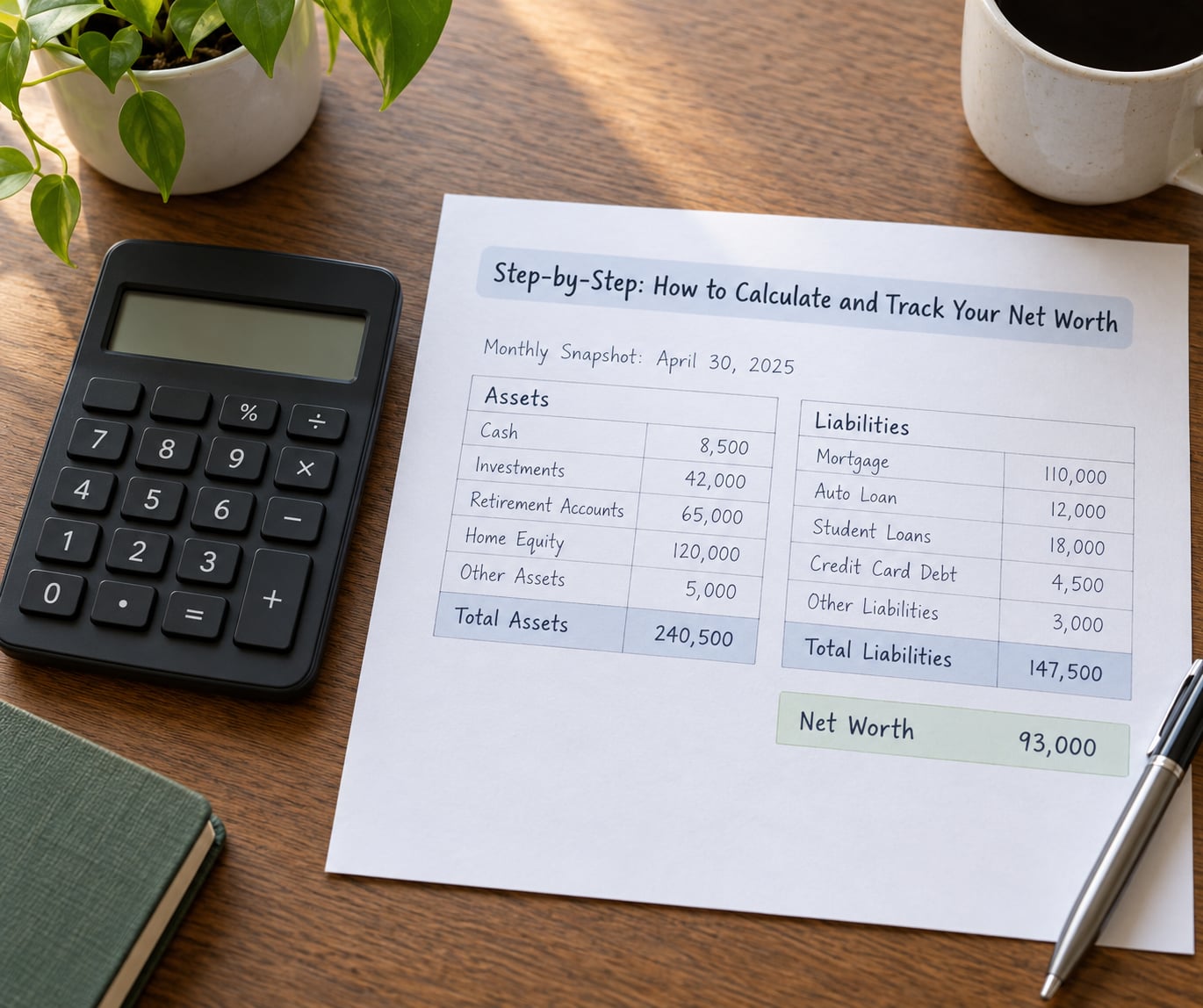
Step 1: Set a Consistent Cutoff Date
Pick one date and use it forever. Many people choose the last Saturday of the month, because weekend statements are usually final by then. Others pick the first of the month and use the prior month’s closing balances.
Whatever you choose, write the date next to the number. A net worth without a date is a rumor; a net worth dated the 28th of every month is a measurement. If monthly feels like too much, bi-monthly snapshots on the 1st and 15th work well and still show you the direction.
Step 2: List Every Asset You Own
Give every account its own row. Grouping accounts into a single “savings total” is where errors hide, because you stop being able to check the number.
The usual asset categories, in the order most people list them:
- Cash and cash equivalents: checking, savings, high-yield savings, certificates of deposit, money market accounts.
- Investments: taxable brokerage accounts, the individual shares and funds inside them, and any cash sitting in a brokerage sweep.
- Retirement accounts: employer 401(k) or 403(b) balances, traditional and Roth IRAs, pension balances, and vested restricted stock or option shares at their market value.
- Real estate: your home, a second property, land, or a rental property. Value each one the same way, every time.
- Vehicles and other property: cars, boats, motorcycles, camper vans.
- Financial contracts: the cash value of a life insurance policy, a long-term care policy, and the amount you could withdraw from a brokerage annuity.
- Business interests: your share of a private company, valued conservatively and kept in a separate column.
- Digital assets and collectibles: keep these in their own column, and use a price you could actually sell at.
Not every asset belongs in the same column, and that is fine. Split your list into liquid assets, which you could convert to cash within a few days, and illiquid assets, which you cannot. Home equity, vehicles, business interests and collectibles are illiquid, even though they are real value.
Step 3: List Every Liability You Owe
Use the balance owed on the cutoff date for each debt. The number on a statement, not the original loan amount and not your minimum payment.
Debts that belong on the list:
- Mortgage balance and any home equity line of credit.
- Auto loans, boat loans and equipment loans.
- Federal and private student loans, plus any payment plan you are on.
- Credit card balances, including store cards.
- Personal loans, small signature loans and buy-now-pay-later balances.
- Unpaid medical bills, legal settlements and taxes you still owe for the prior year.
Unsecured debt such as credit cards matters twice. It counts in the subtraction, and it also costs you far more in interest than a mortgage does, so it belongs in your debt payoff order as well.
Step 4: Calculate Total Assets and Total Liabilities
Subtract one total from the other. That is the net worth formula, and every tracker on the market is just a spreadsheet with better formatting.
Here is a worked example. All figures are US dollars and invented for illustration:
| Category | Line items | Subtotal |
|---|---|---|
| Cash | Checking 3,200 + Savings 11,500 | 14,700 |
| Investments | Taxable brokerage 18,900 | 18,900 |
| Retirement | Employer plan 62,400 + Roth IRA 9,750 | 72,150 |
| Vehicle | Car at private-party guide value | 14,000 |
| Total assets | 119,750 | |
| Student loans | Balance owed | 18,400 |
| Auto loan | Balance owed | 9,600 |
| Credit cards | Balances owed | 2,150 |
| Total liabilities | 30,150 | |
| Net worth | 119,750 − 30,150 | 89,600 |
A negative result is a real result, not a failure. Plenty of Americans in their twenties and thirties finish school or buy a home with more debt than assets, and a number that reads negative is the first honest data you have. The useful move is to track it monthly so you can see it crossing upward.
Notice also that this household has both a total net worth and a much smaller liquid net worth — the 14,700 of cash they could reach today. Tracking those two separately tells you far more than one number does.
Step 5: Separate What Counts From What Does Not
Most net worth arguments are about judgment calls. Decide each one once, write the rule down, and keep applying it. Some that come up constantly:
- Your home. Count the property value and the mortgage separately, or count the equity only. Never do both in different places — double counting the home is the single most common spreadsheet error.
- Retirement accounts. Count the full current balance. Do not subtract what you think you will owe in taxes later, and do not count only the portion you have contributed.
- Your car. Count it at market value if you want it in the total, and track it in a separate column, because it loses value every month while most of your other assets do not.
- Business interests. Include your ownership stake at a defensible value, and keep it out of the liquid column. Valuing a private company at what you would like it to be worth is the easiest way to make your own number useless.
- Collectibles, art and digital assets. Use the price of a recent sale of something comparable, not an asking price. If you cannot name a realistic sale price, put it in a separate memo column instead of the total.
- Disputed or contested items. A disputed medical bill or a pending lawsuit does not belong in the number until it is resolved. Note it below the table so you remember it.
Step 6: Save a Baseline Snapshot
Write down the result, the date, and the method in one note: what you included, what you excluded, and how you valued the illiquid pieces. That single note is what makes the next twelve snapshots comparable.
Keep a copy of the statements you used, and flag the two or three accounts or debts that caused the biggest difference from what you expected. Six months in, that list is usually a payments or contributions figure you forgot about, not a mystery.
This kind of transparency about method is the thing long-time trackers say matters most. On personal finance forums, the trackers who last a decade all describe the same thing: the number matters far less than knowing exactly what went into it.
Step 7: Update It on a Regular Schedule
Pick a cadence you can hold for two years, not one week. Monthly, with about 20 minutes of work, is the most useful because it captures enough market movement to be meaningful. Quarterly is fine if your accounts are mostly cash and your goal is simply to notice the direction.
Not every figure needs the same frequency. Brokerage accounts, retirement accounts and cash change constantly, so they get updated every time you run the update. A home valuation, a vehicle guide value and a business stake can reasonably be refreshed once a year and carried forward in between.
You have three realistic ways to do the updating:
- Manual spreadsheet: you type each balance in yourself. Twenty minutes, full control, no login credentials shared with anyone, and you can decide exactly how the illiquid assets are valued. The risk is that formulas break when you add a new row, so build the totals to handle that.
- Budgeting app that reports net worth: your balances import automatically and the number appears without effort. Investors like this because holdings sync. The trade-off is that most of these tools want direct access to your accounts, which is a real security decision to make on purpose rather than by default.
- Hybrid: the app handles the accounts that link cleanly, and you add the illiquid and hard-to-value items by hand once a year. This is what most long-term trackers on forums like r/personalfinance and r/FIREUK settle on.
Existing community spreadsheets — templates built in Google Sheets or Excel and shared freely — work well here, because you can adapt the categories to your own accounts instead of fighting a fixed structure.
Step 8: Track Net Worth Trends Instead of One Number
One snapshot tells you where you are. A column of snapshots, one per month, tells you whether you are moving. That is the whole reason to keep the history instead of overwriting the file each time.
Put the results in a chart and two things become obvious. First, which months were driven by market swings rather than by anything you did. Second, whether your debt balances are actually falling, which is much harder to feel month to month.
When you compare snapshots, separate the two things that move your number: what you contributed and paid down, and what markets did to you. Contributions and debt payments are the part you control. A down quarter in the market is not a failure of the system you built, and reading it that way is how people quit tracking after their first bad year.
Set one or two milestones from your own baseline rather than from someone else’s number. “Mortgage balance under 150,000” or “six months of expenses in cash” is a usable target. Comparing your number to a stranger’s is not, because you do not know their debts, their timeline or what they did not count.
Common Mistakes to Avoid
Mixing statement dates. A brokerage balance from the 3rd and a credit card balance from the 28th produces noise that looks like progress. Fix: one cutoff date, and every account valued as of that date.
Using purchase price instead of current value. A car and a home are not worth what you paid. Fix: market value every quarter for investments, annually for property and vehicles.
Double counting your home. Adding the property value while also adding your equity, or including the same account in both a “home” row and a “net worth” summary. Fix: one row for the property, one for the mortgage.
Forgetting liabilities. People remember the credit card and forget the medical bill, the personal loan or the prior-year tax balance. Fix: a liability category for every debt type, including the boring ones.
Counting retirement balances as though they were cash. Withdrawing early carries penalties, and a 59-year-old with the same retirement balance as a 32-year-old is not in the same position. Fix: keep retirement in a separate column from liquid assets.
Valuing illiquid assets at retail. Asking prices and dealer estimates are not market values. Fix: last comparable sale, and keep the item in a separate column if you are unsure.
Overwriting your history. If each update replaces the last, you lose the only thing that makes tracking worth the effort. Fix: one row per snapshot, dates down the side.
Tips for Keeping Your Net Worth Organized
Keep one master record. One file, one location, one owner. The moment a second spreadsheet exists, the two will disagree and you will lose trust in both.
Use one row per account with a category column. Then total by category with a sum function instead of adding by hand. That way adding a new account in row 40 does not break the total in row 2.
I rebuilt mine as a single sheet with a category column and totals by formula, and the month-to-month time dropped to about 15 minutes. The category column is the part people skip, and it is the reason hand-added rows quietly break a spreadsheet.
Add a source column. A link to the institution or a note about where the value came from saves you an afternoon every time a figure looks wrong.
Separate liquid from illiquid columns. Two subtotals, one grand total. It is the fastest way to see whether your situation is actually strong.
Store it somewhere you trust. An encrypted drive or a password manager attachment. A net worth file contains your complete financial picture, so treat it accordingly.
Review the categories once a year. Life changes, and accounts open and close. A yearly 15-minute pass keeps the structure from quietly filling with dead rows.
Frequently Asked Questions
What is the formula for calculating net worth?
Net worth equals total assets minus total liabilities. Assets include cash, investments, retirement accounts, property, vehicles and other valuables you own. Liabilities include your mortgage, loans, credit card balances and anything else you owe. Value assets at current market value and debts at the balance remaining on your cutoff date.
How do I track my net worth in Google Sheets?
Build a sheet with four columns: account name, category, value, and a column for notes or source links. List every asset and every liability on its own row, total each side with a sum formula, and subtract. Add a separate tab with one row per month so each update appends a new dated snapshot instead of replacing the last one.
Should I include my home and my car in net worth?
Usually yes, at current market value, and separately for each. Include the home value and the mortgage balance as two different lines, or include only the equity, but never both in different places. Count a car at a private-party guide value and keep it in a separate column, because it depreciates while most of your other assets do not.
How often should I calculate my net worth?
Monthly is the most useful cadence and takes roughly 20 minutes once your sheet is built. Bi-monthly on the 1st and 15th is a good compromise. Quarterly works if most of your money sits in cash. At minimum, do it annually, and always use the same date and the same method so each snapshot is comparable.
Can net worth be negative?
Yes, and it is more common than people assume, especially for people finishing school, buying a first home early or carrying both student and auto debt. A negative figure is not a verdict on your finances; it is a starting measurement. Track it monthly, focus on the debt balances, and most negative positions improve as balances fall and contributions accumulate.
Is 500,000 a good net worth?
It depends almost entirely on your age, income and debt load, not on the figure alone. Compare it to your own baseline, to the cost of the lifestyle you want, and to how much of it is liquid versus tied up in a home. Household figures vary widely by income and region, so treat any published average as context rather than a scorecard.
Start With One Number, One Date
The fastest way to start is tonight. Pick a cutoff date, open your statements, write down every account and every balance on one page, subtract, and date the result. That first snapshot is your baseline, and every one after it is a comparison against something real instead of a feeling.
Once the sheet is built, the whole thing takes about 20 minutes a month. Keep the method the same, keep the history, and read the trend rather than the number — that is how you calculate and track net worth without guessing.