
To open a brokerage account for beginners, the sequence is short: compare the account types, pick a regulated firm, fill in an online application with your personal and tax details, verify your identity, and link a bank account to fund it. The application itself takes about 10 minutes, and most first-time investors can begin buying fractional shares with a small amount once the money settles.
A brokerage account is an account with a licensed firm that holds your money and investments and buys or sells them for you. You own the assets; the firm custodies them, executes your orders and produces your statements. Unlike a bank account, which is covered by FDIC insurance up to 250,000 US dollars, a brokerage account is protected by SIPC, which covers up to 500,000 US dollars of securities with a separate 250,000 US dollar limit on cash.
Beginners ask for this walkthrough constantly. On r/investingforbeginners and r/FIRE, the most common post is some version of “is there a step-by-step somewhere of how to open an investment account?” followed by “I just opened mine, now what?” Both questions get answered below, in order.
Table of Contents
- What You Need Before You Open a Brokerage Account
- Step-by-Step
- Step 1: Compare Brokerage Account Types
- Step 2: Choose a Brokerage Based on More Than Fees
- Step 3: Gather Your Information and Choose a Funding Source
- Step 4: Complete and Submit the Account Application
- Step 5: Verify Your Identity and Wait for Approval
- Step 6: Fund Your Brokerage Account
- Step 7: Make Your First Investment and Review the Account
- Common Mistakes
- Frequently Asked Questions
- Conclusion
What You Need Before You Open a Brokerage Account
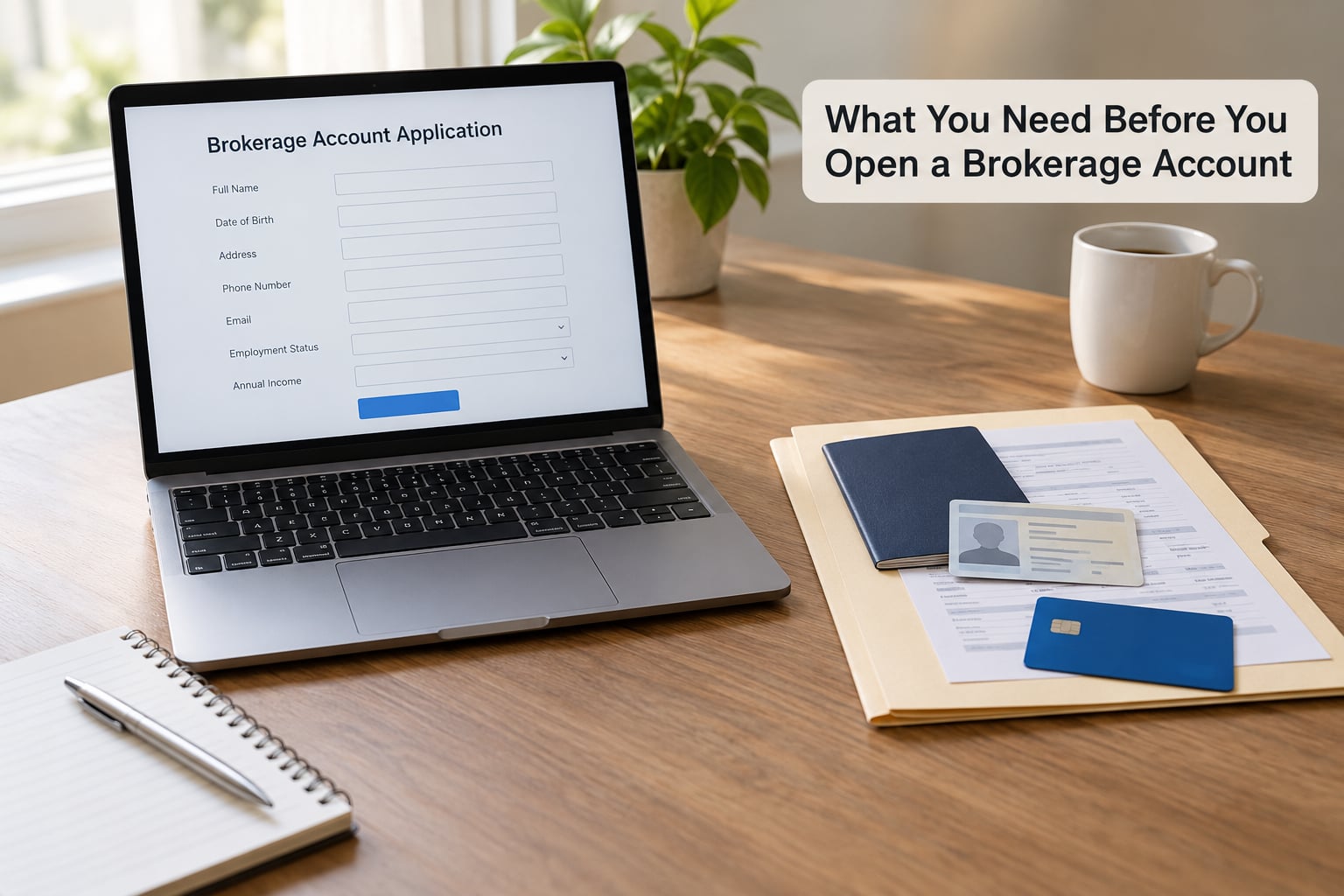
Gather everything in one sitting. Applications usually stall or get rejected over small mismatches, not because the applicant did something wrong.
- Personal details: legal name exactly as it appears on your government ID, date of birth, phone number and email address.
- Social Security number: required for US applicants. Non-US residents generally present a passport number and tax identification number instead.
- Government-issued ID: a driver licence, state ID or passport, plus a utility bill or bank statement showing your current residential address if it differs from the ID.
- Tax information: your filing status and dependents. Taxable accounts require a signed Form W-9; non-US residents file a Form W-8BEN instead.
- Employment details: occupation, employer, whether you are retired, a student or self-employed.
- Income and net worth: the application asks for approximate ranges for Know Your Customer checks. Honest ballpark figures are fine.
- Bank details: the account number and routing number for the checking account you will link to transfer money.
- A device and a secure connection: most applications are mobile-first, so complete them on your own phone or laptop rather than on shared or public Wi-Fi.
One more thing before you type anything in: confirm you are on the firm’s genuine website. Type the address yourself or use a bookmark you created earlier, and check for https and a padlock. A search ad that looks like a broker but is not one is the single most common way beginners hand over banking credentials.
Step-by-Step
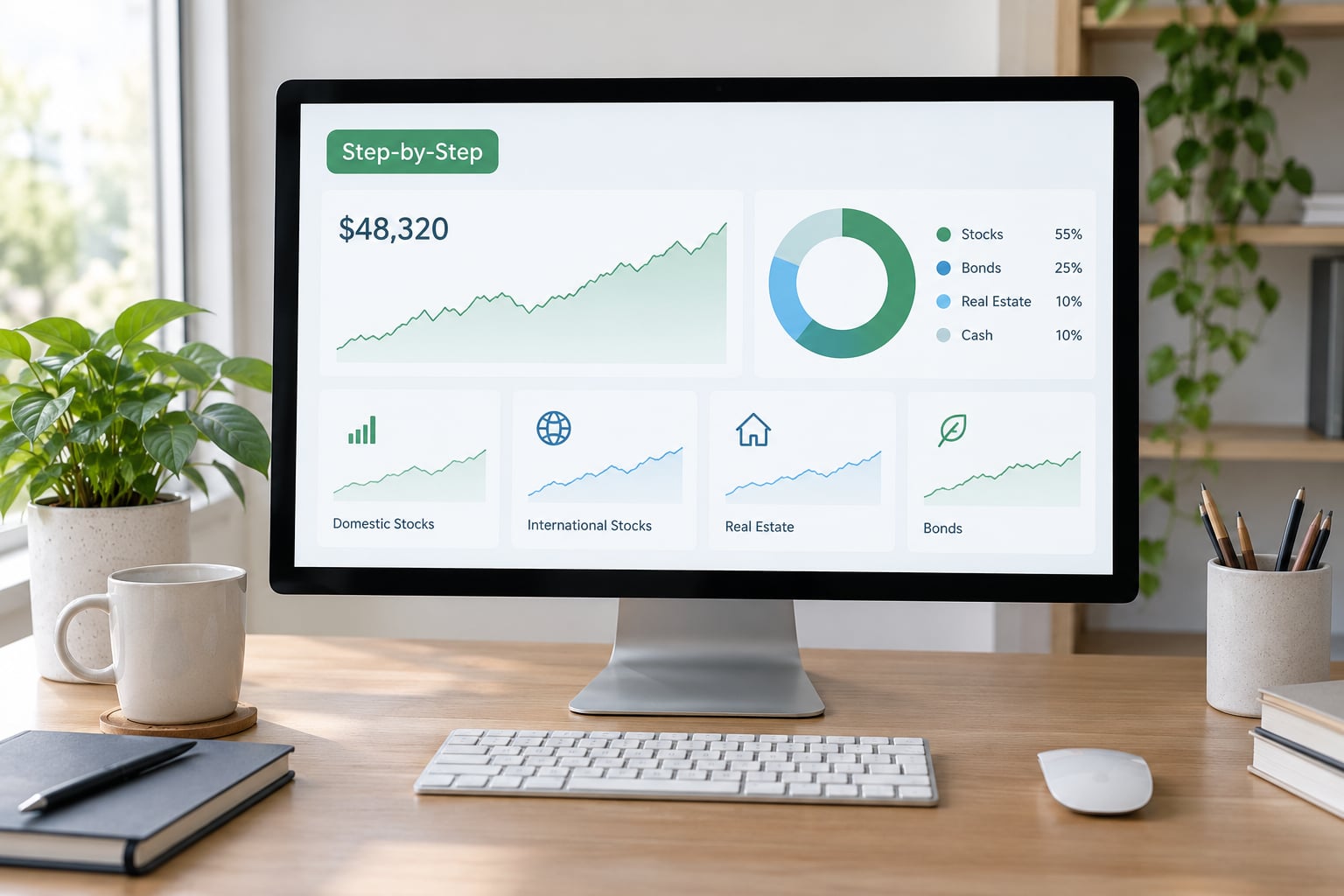
The whole process has seven parts: choose an account type, choose a firm, prepare your details, submit the application, verify your identity, fund the account and make a first investment. Most people finish the application on one device in a single sitting.
Step 1: Compare Brokerage Account Types
The account type decides how your money is taxed, which matters more than the firm you pick. Most beginners open a taxable brokerage account first because there is no annual contribution limit and no withdrawal penalty. If your income is moderate and you are investing for decades, a Roth IRA is often the better starting point because qualified withdrawals in retirement are tax-free.
| Account type | Tax treatment | Limits and access rules | Common fit |
|---|---|---|---|
| Taxable brokerage | Tax on dividends and realised gains; annual loss offsets | No contribution limit, no penalty for withdrawals | Flexible saving, short horizons, extra money after a workplace plan is maxed |
| Roth IRA | No deduction now, qualified withdrawals tax-free in retirement | Annual contribution limit set by the IRS; eligibility rules apply | Younger savers, lower to middle income earners |
| Traditional IRA | Possible deduction now, taxed on withdrawal | Annual contribution limit; early withdrawals can trigger a penalty | Contributors who need the current-year tax break |
| 529 plan | No deduction; growth is tax-deferred, qualified education withdrawals tax-free | Annual limit, approved beneficiary only | College funding for a child |
| Custodial account | Taxed as the child’s income or the adult’s, depending on the account | You control it until the child reaches the age of majority | Investing for a minor |
Contribution limits, income eligibility and penalty rules change, so confirm current figures on the IRS site and with the brokerage before you contribute. If you already contribute to a workplace 401(k) or 403(b), a separate taxable account is often the simplest next step, which is the arrangement many beginners on Reddit describe after sorting out their workplace plan.
Step 2: Choose a Brokerage Based on More Than Fees
Look past the headline commission and compare the whole cost structure and the support around it. A firm can charge zero commission on shares and still make money from account fees, payment-for-order-flow, options contracts and margin interest, so the relevant number is what you will actually pay given how you intend to invest.
- Investment selection: can you buy the broad index funds you want at no cost, or only a limited fund list?
- Account minimum and funding requirements: some accounts require a balance or a monthly deposit to avoid closing fees.
- Non-trading fees: inactivity fees, outgoing transfer fees, wire fees, paper statement fees and fees on account closure.
- Retirement account support: if you want a Roth or traditional IRA, check conversion fees and whether commission-free trades apply inside the retirement account.
- Account protection: verify SIPC membership and the firm’s clearing arrangement, then read how the cash sweep works.
- Platform usability: the mobile app, the web platform, and whether recurring automatic investments are easy to set up.
- Support: real phone support matters in your first year, more than a polished investing course you will not read.
Large established firms such as Fidelity, Charles Schwab, E*TRADE and Vanguard, plus newer app-based options, are all regulated and widely used. The right choice depends on your account type, the investments you want and how much hand-holding you need, not on an advertisement.
Step 3: Gather Your Information and Choose a Funding Source
Before you start the application, open the checklist from the previous section and confirm each item. Decide which bank account you will link, ideally a checking account you can access on your phone, so a failed micro-deposit does not leave you guessing.
Choose the account you want to fund first, since it shapes how long the money takes to arrive. Keep the routing number and account number handy; typing them twice from a handwritten note is how digits get transposed.
Step 4: Complete and Submit the Account Application
Open the firm’s website, select Open an Account and choose the account type you decided on in Step 1. The application walks through your personal details, employment, income and net worth, then tax residency and beneficiary information.
Type your name exactly as it appears on your ID, and make sure your residential address matches your supporting documents. When the form asks about margin, choose the cash account unless you have a clear reason and understand how borrowing works.
A margin account lets the broker lend you money to buy securities, with the broker charging interest on the borrowed amount and able to liquidate your holdings if the balance falls below a required level. For a first account, cash is the safer default: you can always request margin later.
Read the disclosures, sign electronically and submit. You should get an email confirming the application within minutes.
Step 5: Verify Your Identity and Wait for Approval
Know Your Customer checks are standard and almost always part of opening a US brokerage account. The firm usually matches your details against government records, may send a micro-deposit to confirm the bank account, and may ask for a photo of your ID or a signed document.
Approval often lands within hours to a few business days, sometimes longer if extra documents are needed. If nothing arrives after a couple of days, check spam, then call support using the number on the firm’s own website and ask for the status of your application rather than resubmitting it.
If an application is rejected, the reason is usually a name or address mismatch. Fix the exact field rather than opening a second account, which can complicate your records and your tax reporting.
Step 6: Fund Your Brokerage Account
Once approved, link your bank account and transfer money. Electronic transfers are free and take one to three business days; a wire is faster but usually carries a fee; a mailed check takes about a week. The table below shows the trade-offs.
| Method | Typical speed | Cost | Watch out for |
|---|---|---|---|
| ACH or EFT from a linked bank | 1 to 3 business days | Usually free | Daily and per-transfer limits; holds at some firms |
| Wire transfer | Same day or next business day | Often a fixed fee at both ends | Irrevocable once sent, so verify the receiving details twice |
| Mailed check | Several business days plus mailing | Cost of postage | Some firms no longer accept deposits by mail |
| ACATS transfer from another broker | About a week | Varies; sometimes waived | Cash transfers can trigger a tax event, in-kind transfers usually do not |
Electronic transfers can settle faster than the standard two-business-day cycle many brokers publish, so check your account’s deposit page rather than assuming. Newly linked bank accounts are also often limited to a small trial amount for the first few days, which is normal.
If the account name on your bank does not match the brokerage registration, the transfer fails. Confirm the receiving account details from the firm’s funding screen and keep the confirmation receipt.
Step 7: Make Your First Investment and Review the Account
When the buying power appears in your account, start with something broad and low-cost, such as a diversified index fund or a broad market ETF, rather than one company. Funds built from hundreds of holdings spread the risk that any single business fails, and the expense ratio is the fee you actually pay each year.
If the firm offers fractional shares, you can own a slice of a fund for a few dollars, which makes automatic recurring investing practical from the start. Set a fixed amount on a schedule rather than reacting to headlines; forum beginners often describe a first purchase made the same day the account opened, right before a dip.
Understand the two order types before you buy. A market order executes immediately at the next available price. A limit order executes only at your price or better, which protects you in a fast-moving or thinly traded share but may not fill at all.
In your first week: turn on two-factor authentication and login alerts, read the account agreement rather than the promotional email, skim the fee schedule, and set up a small automatic investment. Save the confirmation of your first order, and expect a monthly statement you should actually read.
Common Mistakes
Almost every beginner mistake on forums traces back to speed rather than judgement. Here are the ones that come up, with the fix.
- Opening a taxable account by default without thinking. Many applications default to taxable. Check the selected type before signing; converting later can trigger taxes or fees.
- Enabling margin. Margin interest accrues daily and forced sales can lock in losses at the worst moment. Start with a cash account.
- Investing money you may need soon. Money for a deposit, a car or a tax bill belongs in cash savings, not in shares. Keep a cash buffer inside the brokerage too.
- Buying a single stock to start. One company’s bad quarter then decides your whole balance. Diversify or start with a broad fund.
- Trading too often. Frequent buying and selling produces fees, spreads and short-term capital gains taxed as ordinary income.
- Ignoring the non-commission fees. Inactivity fees, transfer fees and options charges appear on the statement, not the marketing page.
- Leaving account security undone. Enable two-factor authentication, use a unique password, and never act on a link from an unexpected email or text.
- Trusting SIPC for more than it is. SIPC protects your holdings if the broker fails. It does not protect you when markets fall or a holding drops in value.
One more caution worth stating plainly: day trading is not a beginner strategy. Consistent large daily income from trading is not something most beginners achieve, and the accounts that promise a quick monthly figure are the ones most likely to lose you money.
Frequently Asked Questions
Is SIPC mandatory for brokerages?
Yes for US broker-dealers. Firms that handle customer securities must carry SIPC coverage, and you can usually confirm membership in the firm’s disclosures or on the SIPC public list. SIPC is not the same as FDIC insurance and it is not a guarantee against losses in the market. It exists to return your holdings if the broker fails, not to protect you from an investment that falls in value.
What assets are protected by SIPC up to $500,000?
SIPC covers most securities held in your brokerage account: shares, ETFs, mutual funds, bonds and cash held for you at the custodian. Coverage is generally up to $500,000 per customer, with a separate sub-limit of $250,000 on unprotected cash. It does not cover market losses, bad investment decisions, or value lost to trading, and it does not cover products such as futures contracts.
Is it safe to keep more than $500,000 in a brokerage account?
Protection limits apply per customer, per broker-dealer and, in many cases, per account type, so large balances can exceed the coverage you assumed. If you hold more than that, ask the firm directly how your assets are held and whether they are in a network arrangement. Many people spread large sums across firms or add a registered investment adviser. Rules vary by country, so verify current figures before relying on them.
How long does it take to open and fund a brokerage account?
The application takes about 10 minutes and approval commonly arrives within hours to a few business days. Funding is the slower part: an electronic bank transfer usually takes one to three business days, a wire is same day or next day, and a mailed check takes about a week. Once the cash has settled and appears as buying power, you can place an order.
How much money do I need to start investing?
Less than most people expect. Many firms have no account minimum, offer commission-free trades on shares and ETFs, and let you buy fractional shares, so a few dollars is a legitimate starting amount. The more useful figure is the amount you can add regularly and leave invested for years. Start with a small automatic contribution and increase it when your budget allows.
What is the best beginner investment account?
For most people, a Roth IRA is a strong first choice if you qualify, because qualified withdrawals in retirement are tax-free. Otherwise a taxable brokerage account is the most flexible starting point, with no contribution limit and no withdrawal penalty. The deciding factors are whether your workplace plan is already maxed, your income and your time horizon. This is general information, not personal financial advice.
Conclusion
Compare the account types first, since that decision outlives the choice of firm. Pick a regulated brokerage on total costs, account protection and the support you will actually use, not on the commission headline. Then gather your ID, tax details and bank information in one sitting, and apply on a secure device.
Start with a cash account, fund only money you can leave invested for years, and make the first purchase a diversified low-cost fund rather than an individual share. Turning on two-factor authentication the same day you open saves a headache later.
This article is for education only and is not financial, tax or investment advice. Investing involves risk, including the possible loss of principal, and past performance does not predict future returns. Tax rules and account limits vary by country and state and change over time, so check current figures with the IRS and with your brokerage.